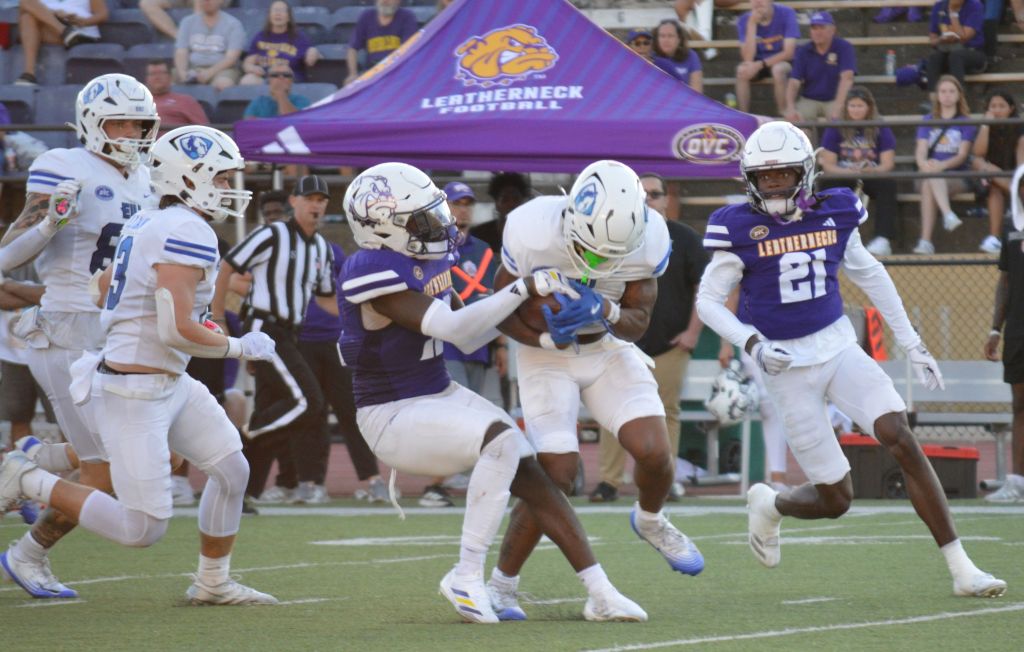
When Eastern Illinois and Western Illinois kick off the 2026 football season in August, the Ohio Valley Conference will be led by new commissioner Matt Wilson. (Photo by Barry Bottino, PrairieStatePigskin.com)
By Barry Bottino
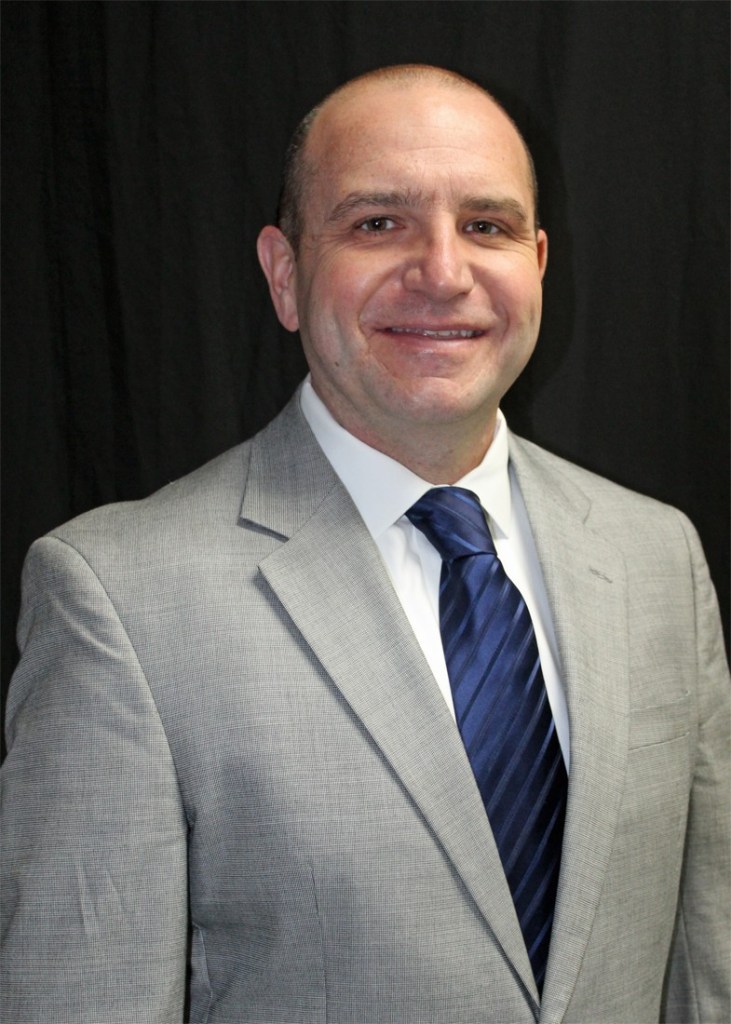
Matt Wilson is no stranger to change.
The new Ohio Valley Conference commissioner, who was hired last month, previously led the Gulf South Conference, which lost six member schools shortly before his arrival in 2014. During his tenure, the 12-team GSC – which plays Division II football – brought in six of its current members.
He takes over a league which lost 2025 league champion Tennessee Tech to the Southern Conference after 76 years in the OVC.
The remaining eight football teams, including Eastern Illinois and Western Illinois, offer a like group of programs that piqued Wilson’s interest in the job.
“The collection of schools. The reputation of the OVC. The reputation of the schools, and the chance to be part of Division I athletics and FCS football just was super appealing,” he told Prairie State Pigskin.
One of the league’s first actions under his guidance came last week when the conference returned to the original OVC branding since its partnership with the Big South Conference began in 2023.
Wilson discussed the importance of recruitment and retention, the value of a relationship with the Big South, regional rivalries and his three key priorities in a recent interview.
Here’s an edited version of the conversation.
PSP: What was appealing to you about the OVC and its football members?
Wilson: The OVC has been an aspirational conference for me for a long time. I’m a middle Tennessee native, the OVC offices have been headquartered here (in suburban Nashville). There’s a long history of Tennessee and Kentucky schools. That’s how I knew the OVC.
Now we’ve migrated a little bit north and west. It’s an exciting group of schools to work for. Our schools look very similar and have similar aspirations as to what they’re trying to achieve. When you have consensus like that, you can do some really exciting things.
PSP: The OVC and Big South conferences have had a football partnership since 2023. Does that relationship have long-term possibilities?
Wilson: I certainly hope so. Collaboration is the way of the future as we move through this new phase of college athletics. We need to be geographically centered. The association doesn’t address all of that, but it does give you a chance to grow and gives you stability and security to grow. Collaborating with other conferences so folks can achieve their institutional aspirations for football is going to be really important.
The days of having nine or 10 members, all playing every sport, all within four or five hours by bus, that’s probably gone. You’re going to coalesce around some geography and around some sports, but it’s not going to be broad-based unless you’re the Ivy League. They’re doing schedules out to 2050, so they’re not too worried about what their membership is going to look like.
The association (with the Big South) is certainly valuable. It came along at a time that the OVC definitely needed it. We still need that collaboration. Gardner-Webb and Charleston Southern are great partners. I think it makes a lot of sense with two teams in that southern region. Folks only have to make that trip every other year. It gives them access to some southern recruiting and some new places to play.
PSP: With Western Illinois coming into the OVC in 2024, it gave Illinois fans the opportunity for that rivalry with Eastern to be reconnected. How will the OVC enhance its regional rivalries?
Wilson: For me, rivalry games are one of the things that makes college football really special. We have to showcase and highlight and value rivalry games and make them as big regionally as they are for the campus communities and the alumni.
I’m hoping we can grow some others. Charleston Southern and Gardner-Webb have a great rivalry (the North-South Barbecue Bowl). Let’s grow them as we can to make sure we’re highlighting those through our ESPN-Plus agreement, through other outlets like yours, other social media and online reporting outlets.
It’s a unique time to be able to promote things in your own way and carry the flag yourself.
PSP: Heading into your first season of OVC football, what’s on your to-do list?
Wilson: The (OVC) Board of Presidents and Chancellors has been crystal clear on what my priorities are. One is membership recruitment and retention. Two is brand elevation and three is financial stewardship, both in resource growth and fiscal responsibility on the expense side.
That’s what we’re going to work on. I’m trying to develop a really good value proposition for potential new members to see the value of being part of the OVC, as well as getting our current members excited and see the value of remaining a member of a strong and secure OVC.
Our primary goal as a conference is to provide athletic opportunities and championships, and policy and governance for schools to compete.
We’ve got a great staff that makes sure that happens every day so that I can go look at some more strategic long-term aspirations related to membership and branding.
PSP: How has your experience in the Gulf South Conference shaped your view of recruitment and retention?
Wilson: I got a lot of chances to work on it in the Gulf South. The Gulf South had a lot of members just in my 12 years.
All of it is relationship building. That’s what I think is the priority. I’ve got to build relationships with presidents and athletic directors and others on campus. You have to provide a value and it has to align with that school’s insititutional aspirations. Those can change. We see Division II schools move up. We see other schools drop programs, add programs. You have to try to keep those aspirations aligned as best you can.
Those relationships and communication will do that. I don’t think you can overfocus on (recruitment or retention) over the other. Obviously the big, splashy news is adding people.
But retaining the group you’ve got, especially when you’ve got a good group that has a lot in common … let’s keep similar collections of folks together to pursue their athletic goals. Our schools have a lot in common right now. Mostly regional public schools, sport sponsorship portfolio looks similar, investments look similar, aspirations look similar.
New members make the bigger splash, but retention is critically important.
PSP: Just over the past year, Tennessee Tech chose to leave the OVC while Southeast Missouri announced it will stay. How similar are your recruitment discussions with potential new schools and your retention discussions with current members?
Wilson: It’s a Venn diagram. There’s some common in the middle that we’re playing for. But when you’re talking about recruitment, why is this opportunity better than the one you’re in right now? It costs a lot of money to change conferences today. There are checks that need to be written to various entities. There’s education that needs to be done among your people. It’s not something people do just on a whim.
On the retention piece, I just need to be really clear on what our members are seeking out of a conference.
There are some schools that are no longer members of this conference that I hope I can get an audience with their presidents and simply ask, ‘What issue was solved by leaving the OVC?’
A lot of times you can drill it down to what issues are you trying to solve? And can your current conference solve them for you without having to leave?
PSP: How will conversations with former members benefit you?
Wilson: That will help inform me as I talk to new members or retain current ones.
It will inform me on strategies that didn’t land for those members. It doesn’t mean they were bad strategies. It just means it didn’t land for those people.
I don’t think anybody goes in trying to develop bad strategies or have bad things happen. I want to know what didn’t land so I can be aware of potholes. I’ve told our staff often, ‘One of the primary goals I need from you all is to keep me out of potholes that I don’t know are there.’
These discussions may help with some of that. That’s what I’ll learn as we go along – what has worked, what didn’t work and what are the pain points that lead somebody to consider a different league.
PSP: What are you looking forward to this fall as football season kicks off?
Wilson: When you look at the non-conference schedules for Eastern and Western, there are going to be some games that their folks are going to be super excited about.
When you look regionally, Eastern is going to get Murray State, Indiana State and Illinois State. The South Dakota State game will be great for publicity. Those are going to be exciting.
Western has Illinois State also and they have Morehead State coming in. Those are going to be exciting.
The Wisconsin (vs. WIU) and Minnesota (vs. EIU) games are going to be great for travel. Kudos to those schools for scheduling well. Those are the kinds of games that get a fan base excited.
If we can keep doing that kind of non-conference scheduling, the urgency to get to nine or 10 teams doesn’t exist the same way as if these schedules were filled with two buy games and then two that you have to pay to get.
That’s a lot of hard work for coaches and ADs.
PSP: For FCS programs, what do you feel is the value of playing FBS teams?
Wilson: I hope that the benefits are obvious, especially the ones that make sense regionally. If one of our schools is going to play at UCLA, that’s a different value proposition for the school to do it.
But when a Tennessee State gets to play Middle Tennessee or Vanderbilt in one of these games or UT Martin gets to go over to Western Kentucky or Louisville, those games are fun. It drives alumni engagement and philanthropy, and it gives you a unique opportunity because in some of these games, our schools are not that far apart talent-wise.
It gives you an opportunity to make a statement and a memory for your football program.
PSP: Fiscal responsibility has become more difficult for some schools. Here in Illinois, a challenge for our FCS schools is that the University of Illinois is seeking more funding as state budgets tighten, which could hurt the state’s FCS schools. How much does the conference aid in financial outlooks?
Wilson: We want to be able to support how we can. Those are difficult conversations that involve a lot of people in state capitals. We want to be supportive. We want to be casting a strong vision of the opportunities that college athletics provide. I often have said outside of the GI Bill and the Pell Grant, college athletics has probably provided more access to higher education opportunities for young people in this country than any other program in this country. That’s good company to be in.
We don’t want to lose sight that there are going to be 80 to 100 football players dressed and ready to go (on fall Saturdays at FCS schools) and 63 scholarships available out there. If we aren’t able to secure funding and make it make sense for people, that takes away opportunities for young people to reach their education aspirations.
Barry Bottino is a co-founder of Prairie State Pigskin and a 19-year veteran of three Illinois newspapers. He has covered college athletics since 1995.
Find us on social media!
Twitter/X: https://twitter.com/PSPigskin
Facebook: Prairie State Pigskin
Instagram: Prairiestatepigskin
Blue Sky: PSPigskin


Leave a Reply