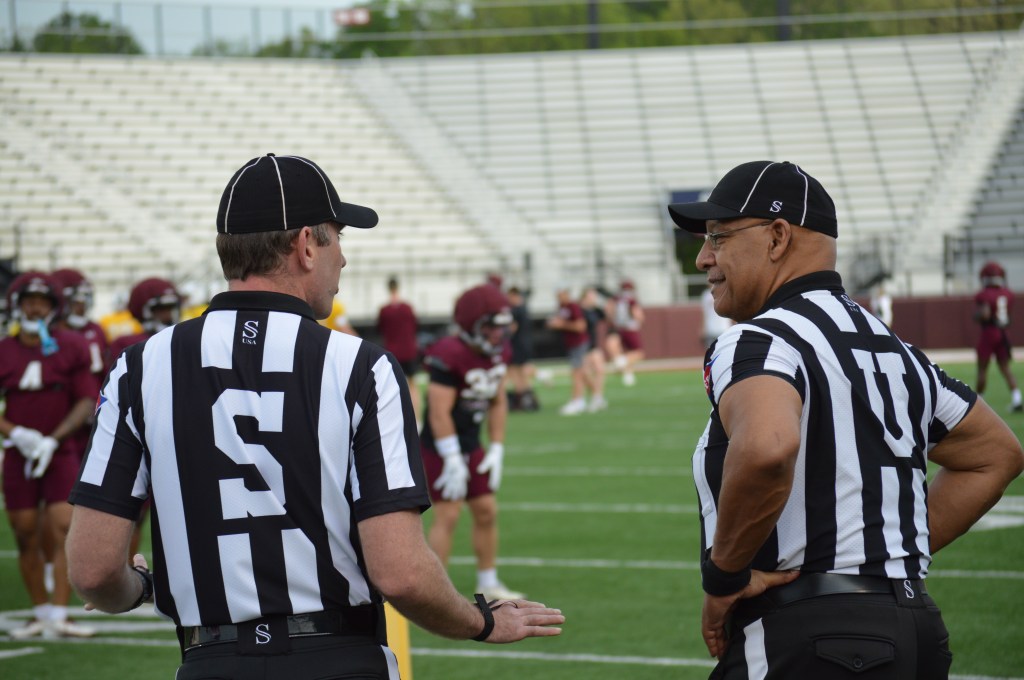
College football officials will have rules changes to enforce this fall, including punt formations and adjustments to existing targeting rules. (Photo by Barry Bottino, PrairieStatePigskin.com)
By Dan Verdun
Punt formations and targeting penalties will see adjustments via college football rules changes for the 2026 college football season. However, one possible change will not go into effect this fall.
With Illinois FCS teams less than three months away from a new season, here’s a look at each rule change and the potential impact:
Punt formation and eligible receivers
According to Matt Young, Ohio Valley Conference officiating coordinator, this change came about from “a desire within the rules committee to clean up some of the ways that punting teams were able to take advantage of the numbering exception rules.” The goal is to alleviate potential confusion on punts.
Traditionally, the five linemen on a punt protection team were numbered 50 through 79. With the exception, you could have a player wearing a different number in that formation line.
“You could have a No. 31, for example, lined up as a left guard where it made it almost impossible for the defense to know who was eligible and who was not for receiving a forward pass if they were to fake the punt or run a play out of that formation instead of punting,” Young explained.

This season, teams will still be allowed to insert a player numbered other than 50 through 79 in what Young termed a “two-by-two formation” in the tackle box. However, that player will count as one of the five linemen and be an ineligible receiver, he said.
“It’s going to be a much easier rule to officiate because you’ll have a little bit less to account for,” Young said. “In some respects, the cat-and-mouse games that teams were using on offense to try to be deceptive for the defense is being taken away.”
Veteran Illinois State associate head coach Kye Stewart coordinates the Redbirds’ special teams. He views the rules changes from different perspectives.
“It depends on what you do as a punt team,” Stewart said. “For some people, if they did all the (different) formations, you probably hate the rule change because you don’t have that competitive advantage.
“Conversely, if you’re the punt return team, you’re excited about it because it almost became a situation where it could be another offensive play with the amount of formations, shifts and eligibles (receivers).”
Joshua Caraway coaches special teams at Western Illinois.
“When you look at schematics in football, you always want to heighten the game,” he said. “Before the rule change, especially in college, you could be really creative and inventive. You could disguise a lot of eligibles. There were a lot of things you could do. I thought that heightened the game.”
Caraway, however, admits there are still ways that special teams coaches can gain an advantage.
“With this new rule, it doesn’t make special teams as inventive as it can be,” Caraway said. “However, after talking with different referee crews and buddies of mine in the special teams community at Division I schools, there are still ways you can be creative and inventive.
“If anything, it’s going to force us as coaches to take it to the next level with schemes on how they block things down and how they cover. So, the punt isn’t any worse off with this rule. Much like we tell the players, we have to adapt to the changes.”
What else could this rule change mean?
“It’s going to remove, at least for those five players, a last-second shift and (the defense) wondering if that guy is still eligible or not,” Young said. He also points out the offensive team can still “line up however they want if they have five players (numbered) 50 to 79 on the line of scrimmage.
“So, you can either put the big boys back out there, or what you might see are some teams that will change jersey numbers a lot,” he said.
Eastern Illinois head coach Chris Wilkerson noted that teams can still have unbalanced formations.
“It’s not really going to change our base protections,” he said. “If you’re trying to create the center as the last player on the line of scrimmage and run some fake and throw him down field, it’s going to eliminate some of that. It’s not gone to the extent of the NFL, but that would make it quite easier if they did.”
Young added that there is “a mechanism in place this year for teams to report their scrimmage kick formation numbering changes” before kickoff.
“Teams can hand a card to the officials (in the pregame) and then that information would get shared with the opposing team,” he said.
That information will also be shared by officiating crews during the game. To date, teams are not required to share such information during the week leading up to the game.
“It’s still being flushed out,” Young said.
Stewart, who played linebacker at ISU and has been a Redbird assistant for the past nine seasons, said there is a potential for more game-changing plays by teams receiving a punt.
“You might see more (punt) blocks because you’ll have an opportunity to be more aggressive,” he said. “It’s always interesting to see the rules changes and how people will adapt.”
Penalty structure for targeting
In March, the Division I Football Bowl Subdivision Oversight Committee approved a one-year trial rule to modify the penalty structure when players are penalized for targeting.
Under the rule, a player disqualified for targeting for the first time during the season, regardless of which half it occurs, may participate in the next game, according to NCAA.org.
“That’s a significant change,” Young said.
Any player disqualified for targeting a second time during the season will be required to miss the first half of the next game.
“To put that in context, there were only six players at the FBS level and only three players in FCS that received a second targeting foul during the season,” Young said. “One of the things that certainly has improved in college football is the reduction of confirmed targeting because the game is being played better.”
If a player is disqualified for a third targeting penalty during the season, the player will be required to miss the entire next game. No players were disqualified for targeting three times in the 2025 season, according to the NCAA.
A conference has the option to initiate an appeals process after a player’s second targeting offense. The appeal, which can cover the first and second targeting offenses, would be sent to the NCAA national coordinator of football officials, who would then facilitate a video review.
If the call is overturned on appeal, the player will be able to play without sitting out the first half of the next game.
Previously, players disqualified for targeting would be disqualified for the remainder of that game, and if the foul occurred in the second half, the player would sit the first half of the next game.
Since the 2022 season, conference offices have been allowed to appeal second-half targeting disqualifications to the NCAA national coordinator of officials in hopes of having the call overturned so the player would not have to miss the first half of the next game.
No standard pant length
A potential rule change standardizing the length of pants was passed by the rules committee, but the FBS/FCS oversight committee did not approve the change.
“The change coming out of the rules committee would basically have been a no-skin gap policy between knee to ankle. There are no rules changes this season as it relates to equipment,” Young said.
This potential rule has generated plenty of debate.
Young noted that the rule book mandates properly worn knee pads as part of standard equipment. However, that has generally not been enforced in the last 15 years or so, he said.
“It’s extremely unpopular to be stopping a game to be uniform police and taking timeouts away or penalizing or something like that,” Young said. “And honestly, in this time period we’re in, especially at higher levels in terms of NIL, some coaches just aren’t going to enforce certain things within their own team.”
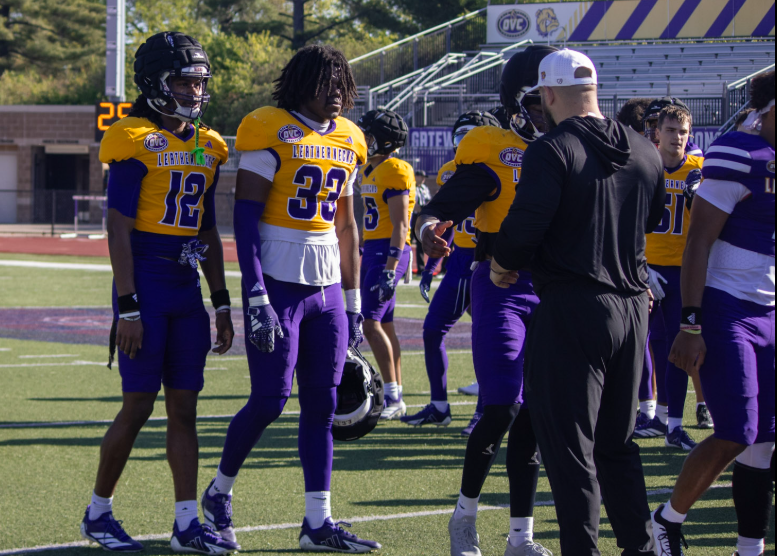
Some argue that it would be a heavy burden on programs with limited budgets to potentially buy up to 200 new pairs of pants.
“We don’t have a whole lot to do with that until it becomes a problem for us,” Wilkerson said.
Southern Illinois head coach Nick Hill said he was in favor of the uniform rule change.
“Some of these guys get out of hand. All of us coaches would agree if we said to our teams, ‘Raise your hand if you want to play in the NFL.’ They all raise their hands. Well, you don’t see (varying pants length) in the NFL.”
Many of the players Prairie State Pigskin surveyed said the potential pants length rule wouldn’t affect them one way or the other. However, there were those that were strongly against it.
Western Illinois defensive back Don Paul Keith was one such detractor.
“I need my knees to be free. We’re hitting people and not getting hit by anybody, so why not have our knee pads above our knees? I feel like it affects our movement. We’ve been doing it this way for a while. Why not have a little bit of freedom,” Keith said.
Other approved changes
- A team can choose to attempt a kick after a completed or awarded fair catch, according to NCAA.org. The kick will be a field goal place kick with a holder (no tee) or a drop kick from the spot where the returner caught the ball. If the ensuing kick goes through the uprights, it will add three points to that team’s total. The defense is required to be at least 10 yards from the spot of the kick. This rule further aligns Division I with similar rules that exist in NFL and high school football.
- While the Division I Football Rules Subcommittee is comfortable with the administration of unsportsmanlike conduct penalties, the oversight committee approved clarifying the rule to give on-field officials guidance to align with the current game. Officials will focus on unsportsmanlike conduct where a player taunts an opponent; actions that interfere with game administration; and celebrations found demeaning to the game or opponent.
- Offensive pass interference penalties will be 10 yards. Previously, the penalty for offensive pass interference was 15 yards.
Barry Bottino contributed to this story.
Dan Verdun is a co-founder of Prairie State Pigskin. He has written four books: NIU Huskies Football, EIU Panthers Football, ISU Redbirds Football and SIU Salukis Football.
Find us on social media!
Twitter: https://twitter.com/PSPigskin
Facebook: Prairie State Pigskin
Instagram: Prairiestatepigskin
Blue Sky: PSPigskin
 Prairie State Pigskin
Leave a comment