
For Illinois FCS coaches such as Illinois State’s Brock Spack, the early high school signing period is scheduled from Wednesday, Dec. 4 to Friday, Dec. 6. (Photo by Barry Bottino, PrairieStatePigskin.com)
By Barry Bottino and Dan Verdun
The college football early signing period for high school players is seven days away. Yet, so much has changed in the transfer portal era.
“We’ve been done with (high school) recruiting a long time ago, like June or July,” Illinois State head coach Brock Spack said. “We’ll look in this next transfer window and see what’s out there for us.”
Southern Illinois head coach Nick Hill said, “We could have a full press conference on that. It’s definitely changed, there’s no question about that.”
Those changes aren’t necessarily in the best interests of high school hopefuls and their parents in search of scholarships.
“Your roster changes more in this era,” Hill said. “There are some unknowns that come into play, (such as) how many spots do you have? How aggressive do you want to be in the transfer portal combined with the high school recruiting?
“As a whole, there are fewer high school players taken on scholarships (now). Some of that will change with the amount of walk-ons that can be taken with roster caps.”
Roster cap rumblings
The caps that Hill refers to are a direct result of The House vs. NCAA settlement, which paves the way for colleges to directly compensate athletes. Those measures – which are expected to be finalized in April – call for a maximum roster cap of 105 FBS players, which could have an impact on FCS teams.
Tom Miller of the Grand Forks (N.D.) Herald covers University of North Dakota athletics, including the Fighting Hawks football program, which closed its season with a Nov. 23 Missouri Valley Football Conference loss at Illinois State.
In a recent story “FBS roster caps are about to have a major impact on the FCS,” Miller noted the average FBS roster this fall is around 128 players. Under the current rules, FBS programs offer a maximum of 85 scholarships. Under the new rules, those schools can offer scholarships to the full roster of 105 players.
FBS head coaches the likes of Dabo Swinney of Clemson and Matt Ruhle of Nebraska have been outspoken about being “out-legislated (for) the true walk-on programs in college football.”
So, what does this all mean for FCS programs, including the four Illinois schools?
Potentially, it could mean more talent filtering down as FBS programs will offer 20 more scholarships, yet will not longer be able to maintain vast groups of walk-ons.
In recent years, many FCS programs have recruited players from the lower levels of college football. For example, Illinois State got safety Keondre Jackson and linebacker Amir Abdullah from Division II Nebraska-Kearney. The Redbirds added tight end Cam Grandy – now with the NFL’s Cincinnati Bengals – for the 2023 season from D-II Missouri Western.
Eastern Illinois landed impact receiver Justin Thomas from D-III Albion College before the 2022 season. Cameren Smith, who led Western Illinois in rushing this season, arrived from D-II Missouri S&T.
Portal’s two-way street
The ruling doesn’t mean FCS programs will stop going after FBS transfers. All four Illinois FCS coaching staffs add drop-down players each year to their rosters.
However, as recent history has shown, it’s a two-way street.
In 2021, ISU defensive lineman John Ridgeway – a Bloomington, Ill., native – left the Redbirds for FBS Arkansas. After last season ended, SIU lost linebacker Branson Combs to Wake Forest and cornerback Mark Davis to Vanderbilt. Defensive back Blake Ruffin departed EIU for Louisville.
“The recruiting hats never come off. It’s 365 days a year,” Eastern head coach Chris Wilkerson said.
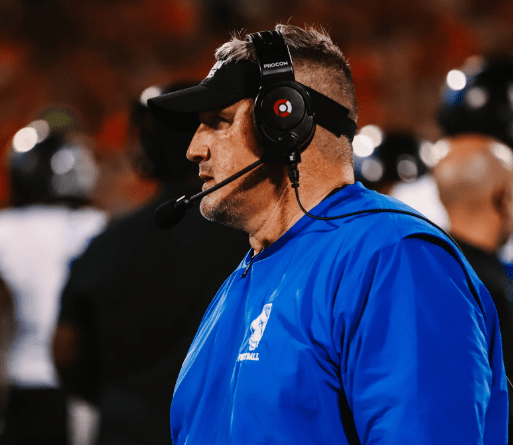
Wilkerson, an EIU graduate who just completed his third year at his alma mater, noted in today’s collegiate athletics landscape, staffs aren’t just recruiting potential additions. They’re also trying to keep current rosters intact as much as possible.
“We had meetings with a handful of players on Sunday and Monday, then players are off for Thanksgiving,” Wilkerson said after the Panthers’ season-ending game last weekend. “When they come back from Thanksgiving, we will talk to them about all the different opportunities that every single student-athlete has to make a decision about.”
The fall transfer portal opens Dec. 9 and runs through Dec. 28.
“We want to make sure we educate them on what that looks like and what their options and opportunities are,” said Wilkerson, adding that his staff sits down with every player in EIU’s program during that week before final exams.
“Communication is of the utmost importance,” Wilkerson said. “You want to make sure your players understand exactly where you see them. You want to make sure they understand where you see them going forward and make sure you show a plan for each one of them.
“We’ll be very active during that time period.”
Western Illinois Joe Davis just completed his first season as a head coach. He spent two decades as an assistant, including two seasons as EIU’s offensive coordinator. Like Wilkerson, Davis views communication as key.
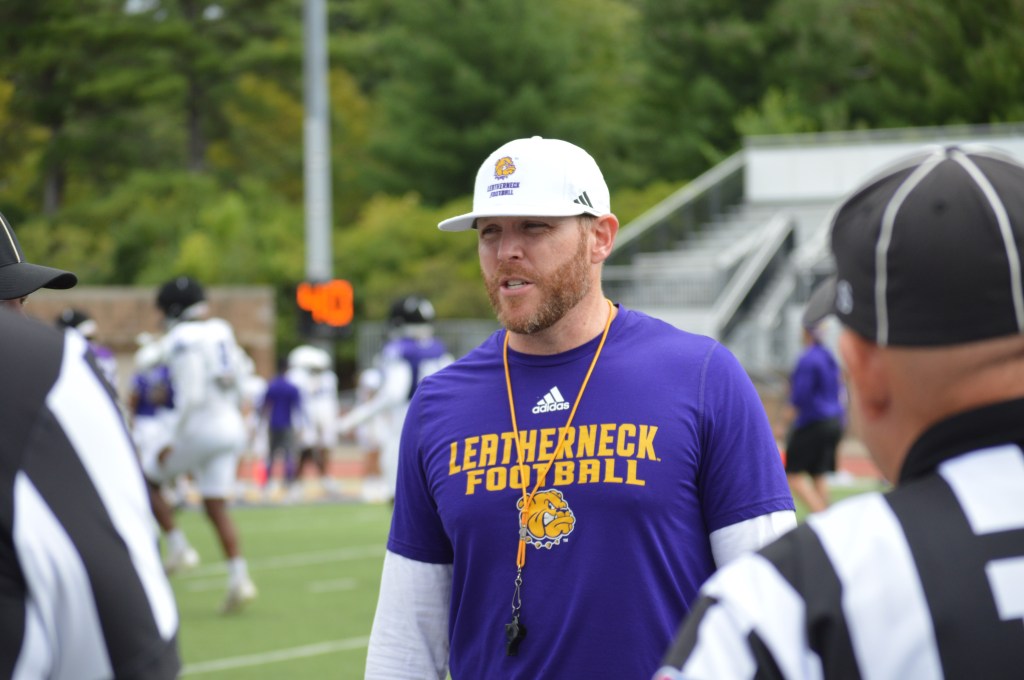
“We’re going to try here to paint some reality to the players,” Davis said. “The transfer portal is not really a new thing anymore. Let’s look at some past data and players that are similar to you with similar production, and here’s where they’ve gone. Is that what you’re looking for?
“If it is, then let’s help you. We want what’s best for you.”
Davis also said there are misconceptions about the portal signing date.
“When they verbally commit to you, they’ll sign an institutional aid agreement, which is basically their scholarship papers,” he said. “But there’s not a lot binding portal guys to your school until they’re boots on the ground walking into the first day of class in January.”
Title IX impact
Hill’s wife, Alicia, played volleyball at SIU. They are the parents of three daughters.
So it shouldn’t be a surprise that the ninth-year Saluki coach also noted the impact of Title IX – the 1972 legislation that requires schools that receive federal funding to provide equal athletic opportunities for all students, regardless of gender – on collegiate athletics including football.

“Things have changed. Each school is a little bit different with what their philosophy is,” Hill said. “I still believe here that signing a great high school class, even though it is smaller than when I first became a head coach (in 2016), is really how you have to do it.”
Hill pointed to this year’s injury-riddled Saluki roster as a prime example as to why.
“Looking out there (on the field) the last two weeks and seeing two true freshman defensive ends at times, and then three redshirt freshmen (were needed for us to play),” he said. “You have to have those guys on your roster coming up in your culture, being coached and developed and then they’re ready to go at some point. Then you can supplement your roster through the transfer portal. I think it’s paramount to be able to sign a great high school class.”
Key offseason dates
- Early signing period: This period is from Wednesday, Dec. 4 to Friday, Dec. 6.
- Midyear junior college transfers: The signing period for Division I and II midyear juco transfers is from Dec. 4, 2024, to Jan. 15, 2025.
- Regular signing period: The regular period for college football is from Feb. 5 to April 1, 2025 for Division I.
Barry Bottino is a co-founder of Prairie State Pigskin and a 19-year veteran of three Illinois newspapers. He has covered college athletics since 1995.
Dan Verdun is a co-founder of Prairie State Pigskin. He has written four books: NIU Huskies Football, EIU Panthers Football, ISU Redbirds Football and SIU Salukis Football.
Find us on social media!
Twitter: https://twitter.com/PSPigskin
Facebook: Prairie State Pigskin
Instagram: Prairiestatepigskin

 Prairie State Pigskin
Leave a comment