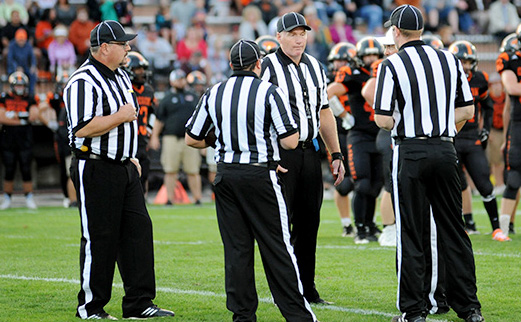
The two-minute warning, long part of the NFL’s rules, will be used in college football beginning this season. (Photo by CoachAD.com)
By Barry Bottino and Dan Verdun
While the four Illinois FCS head coaches are in favor of the new two-minute warning rule being implemented in college football this season, they differ when it comes to the use of technology.
Prairie State Pigskin got reactions from Brock Spack of Illinois State, Nick Hill of Southern Illinois, Chris Wilkerson of Eastern Illinois and Joe Davis of Western Illinois on the upcoming changes for the 2024 season.
Here’s a look at those rules modifications along with some of their reactions:
Two-minute timeout
The NCAA Playing Rules Oversight Panel approved adding an automatic timeout when two minutes remain in the second and fourth quarters.
This rules change synchronizes all timing rules, such as 10-second runoffs and stopping the clock when a first down is gained in bounds, which coincides with the two-minute timeout, according to NCAA.org.
“You get an extra timeout in each half, that’s the way I look at it,” Spack said. “That’s going to be really interesting at the end of the game.
“I think it’s a good rule. I like it.”
Hill, Wilkerson and Davis also gave their thumbs up to the timeout mandate.
“It’s going to be nice (because) you get a fourth timeout in essence,” Wilkerson said.
Hill noted that most coaches have grown up with two-minute warning being used in the NFL. However, he added that there will be a bit of a learning curve for college coaching staffs.

“With media timeouts and a two-minute warning, I do think that as a head coach, you’ve got to study it and make sure you do your due diligence,” Hill said. “You may feel like you can use a timeout earlier, knowing that you’ve got the two-minute warning coming.”
The 39-year-old SIU head coach noted that there are numerous natural stops during the course of games.
“You can collect your thoughts and talk to your team without taking a timeout,” he said. “At the end of the half and end of a game, it’s a good rule.”
Davis spent the past 20 years as an assistant coach at various programs around the country. He was hired as WIU’s head coach this past winter.
“I’m an offensive guy. What’s not to like?” he said.
Optional technology rules
While Football Bowl Subdivision (FBS) teams will have the option to use coach-to-player communications through the helmet to one player on the field this fall, Football Championship Subdivision (FCS) programs will not.
However, for all three divisions, teams have the option of using tablets to view in-game video only. The video can include the broadcast feed and camera angles from the coach’s sideline and coach’s end zone, according to NCAA.org.
Both the Big South-Ohio Valley Conference Football Association and the Missouri Valley Football Conference have approved the use of tablets by coaches and players for the upcoming season.
Eastern Illinois and Western Illinois compete in the Big South-OVC, while Illinois State and Southern Illinois are members of the MVFC.
While the technology certainly has its benefits, it also adds another expense to athletic budgets.
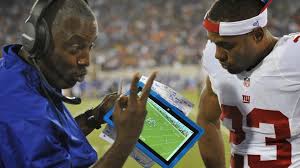
“I don’t think they (the league office) want some teams to have it while some teams don’t. That would be an imbalance,” Wilkerson said.
Spack said, “It’s probably an expense we really don’t need.”
Davis, who spent the past two seasons as EIU’s offensive coordinator before heading to Macomb, expressed guarded interest.
“We’re exploring that,” Davis said following WIU’s spring game in April. “I’ve always been a (sideline) signal guy and we were doing some of that tonight, but I’m very intrigued (by the use of electronic technology).”
Intrigued to the point that Western will give it a trial run.
“We do have a company that is going to come into fall camp. We’re going to test it out. We’re going to see,” Davis said. “If we like it, we’ll buy it and use it. If not, we might kick that can down the road. It’s something we’re going to explore. They’ve been doing it in the NFL for 50 years.”
Hill looks at the new use of technology from varied perspectives.
“If I was an assistant coach up in the box, I would’ve loved to have those tablets,” he said. “It’s unbelievable. It’s time every other level has them.”
Hill noted that high school coaches use them on Friday nights and NFL coaches do the same on Sunday.
“I think it’s the way that football is and it’s time for us to have them,” he said.
Meanwhile in Normal, Spack is not so receptive.
“Me personally? I know the young coaches really like it, and I don’t know if the players will like it, and I’m sure it will make it a little easier, but I’m not a big fan of it,” said Spack, who begins his 16th season at ISU this fall.
Spack, a former Big Ten linebacker and defensive coordinator, elaborated on his stance.
“In-game coaching and being able to see the game with your own two eyes are part of the game,” Spack said. “Training your eyes with what to look for. I think you’re taking a little part of the game away.”
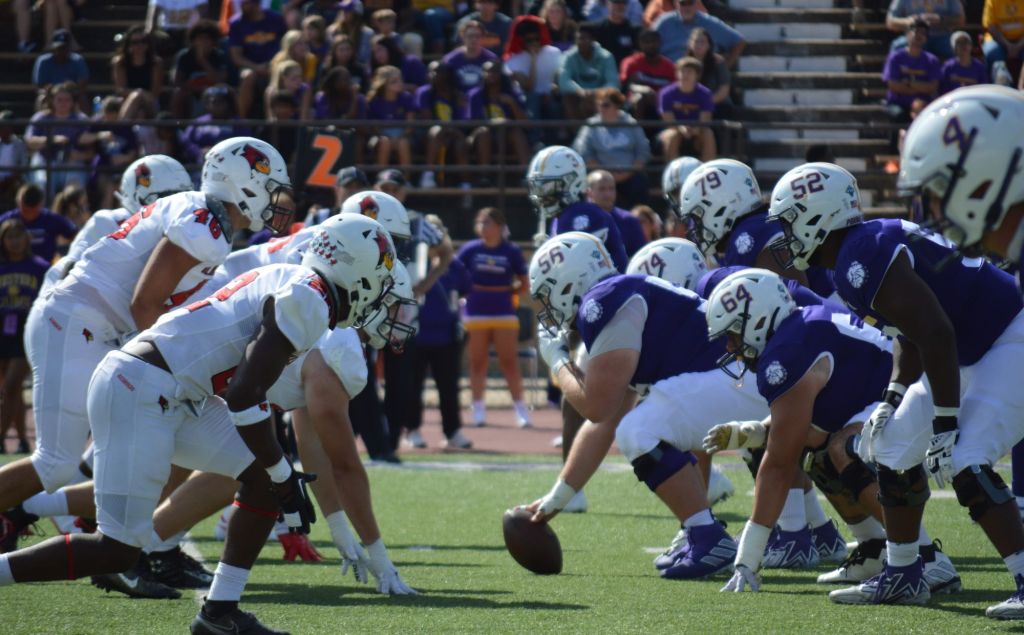
The 62-year-old Spack isn’t against technology having a place in college football.
“It’s great to prepare for a game and for after a game,” he said. “We can watch a whole game on our Ipads if we’re bussing home or on an airplane ride.”
Spack just doesn’t care for the usage during games.
“I’m probably different from a lot of coaches. I don’t think we should use those Ipads on the sideline,” he said. “A big part of coaching is being a good teacher and being able to communicate, to put things simply into words. I think it’s part of being a player. Understanding communication has always been a part of our game.”
One interesting side note of the NCAA Playing Rules Oversight Panel’s decision is that FCS teams are allowed to use wearable technologies in an experimental phase when playing FBS opponents this season.
However, Spack doesn’t see that as being beneficial to his team, which opens the season Aug. 31 at FBS Iowa.
“We won’t be using the (on-field) headsets with the earpiece this year,” Spack said. “We will not use them in the game because we won’t be using it the rest of the season. It doesn’t make sense to use it for only one game. It will just make it confusing.”
According to NCAA.org, teams can have up to 18 active tablets for use in the coaching booth, sideline and locker room. Tablets cannot be connected to other devices to project larger additional images and cannot include analytics, data or data access capability or other communication access. All team personnel will be allowed to view the tablets during the game.
Horse-collar tackles
These types of tackles within the tackle box will now be assessed a 15-yard personal foul penalty. Previously, a horse-collar tackle within the tackle box was not a foul.
“That should make it easier to officiate.” Spack said. “Most fans probably didn’t know that if it happened in the tackle box it was legal, but now it’s not. It makes sense to expand the areas that foul can be called. It’s a safety issue so I have no problem with that. You shouldn’t be tackling that way.”
Rejected proposal
The panel did not support a uniform rule proposal made by the committee. Panel members were not comfortable with on-field officials having to enforce the recommended rule.
The panel understands the rules committee’s concern but encourages the committee to look for an administrative solution that does not include game official enforcement, according to NCAA.org.
Dan Verdun is a co-founder of Prairie State Pigskin. He has written four books: NIU Huskies Football, EIU Panthers Football, ISU Redbirds Football and SIU Salukis Football.
Find us on social media!
Twitter: https://twitter.com/PSPigskin
Facebook: Prairie State Pigskin
Instagram: Prairiestatepigskin

 Prairie State Pigskin
Leave a reply to Mike Fitzgerald Cancel reply