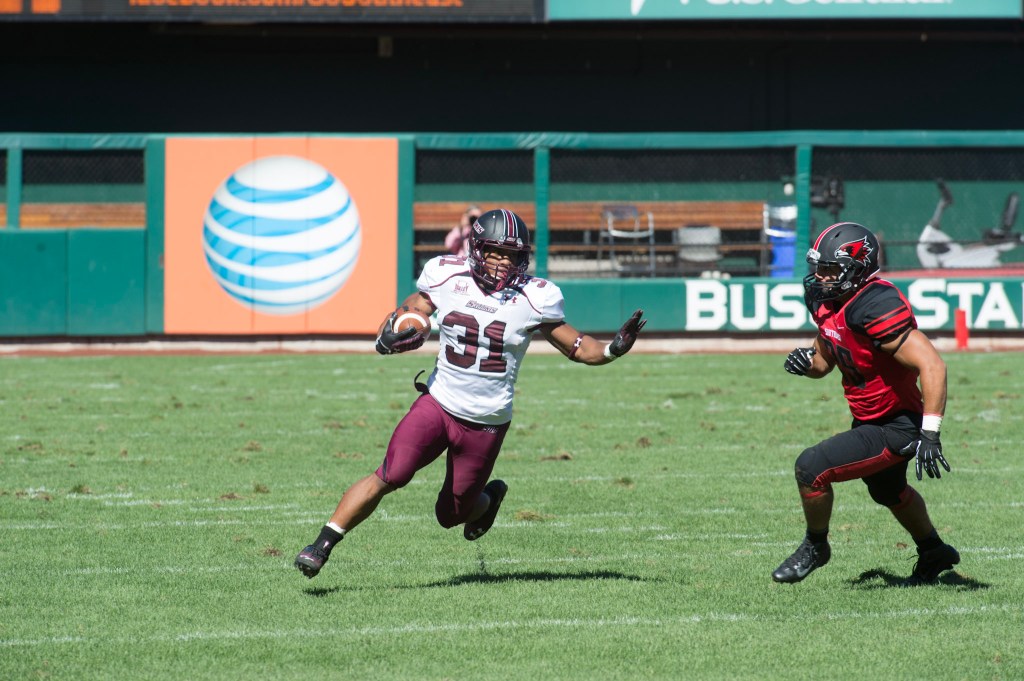
Sparked by running back Malcolm Agnew (31), the SIU Salukis rallied to defeat regional rival Southeast Missouri, 36-19, at Busch Stadium in St. Louis in 2013. (Photo by Saluki Communications)
By Dan Verdun
A decade ago, Southern Illinois played a role in FCS history when the Salukis took on regional rival Southeast Missouri State in a football game at Busch Stadium in St. Louis.
The game, which came three years after FBS foes Illinois and Northwestern squared off at Chicago’s Wrigley Field, was the first of its kind at the FCS level.
“The benefits were obvious for both programs since we were each very active in the St. Louis area and had a lot of players from there. There were recruiting benefits, of course,” then-SIU head coach Dale Lennon told Prairie State Pigskin.
But could an Illinois FCS team play today in a professional stadium? We examine the possibility and the unique factors at play, such as giving up a home game, potential big-city venues and, of course, revenue.
How the game came to be
In the years prior to the game, Mario Moccia and Mark Alnutt worked together in the University of Missouri athletic department.
Moccia departed Columbia in 2006 to become the athletic director at Southern Illinois in Carbondale. Alnutt – a former Mizzou football player – stayed until 2012, during which time he was part of discussions about Busch Stadium hosting a Missouri-Illinois football game.
In 2012, Alnutt was hired as the Southeast Missouri athletic director. Alnutt approached Chris Roseman of the St. Louis Sports Commission about his new school playing football at Busch, home of Major League Baseball’s Cardinals.
With Southeast Missouri and SIU playing annually as regional rivals from different conferences and both schools having ties to St. Louis, the odds increased.
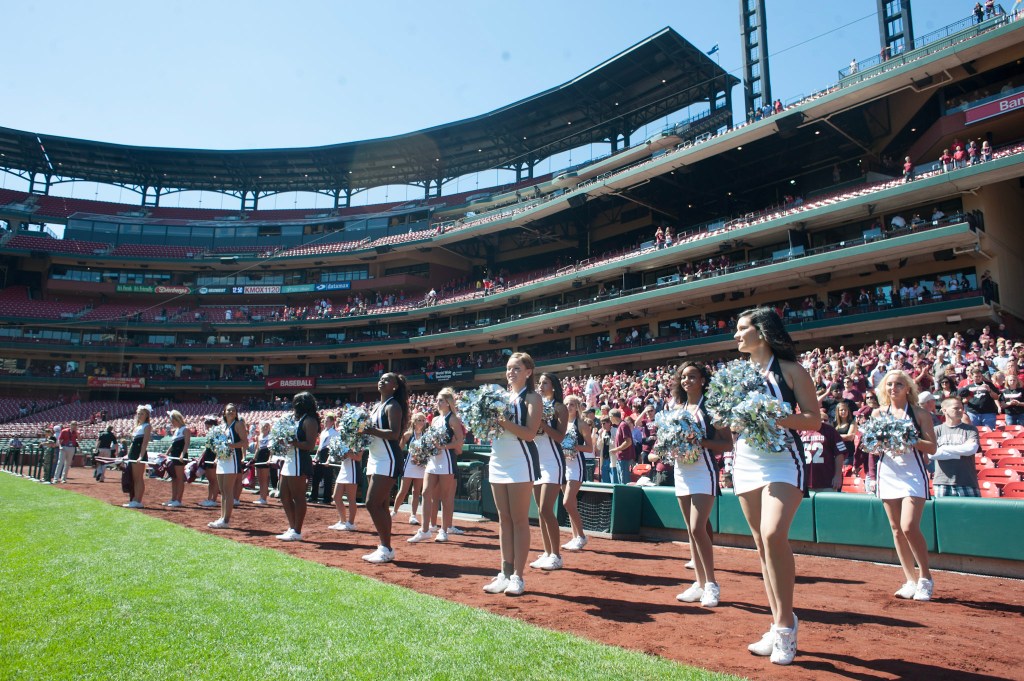
A key factor was that 2013 was a year in which Southeast Missouri was scheduled to host the game with the Salukis.
“We probably would not have wanted to take a game out of Carbondale because we were rolling then (with successful teams),” said Moccia, now the athletic director at New Mexico State.
Terms were worked out and “we moved forward,” he said.
Lennon said, “The best thing was that it would be Southeast Missouri’s home game, so the game wouldn’t count against us.”
The matchup was set for Saturday, Sept. 21.
“The buildup was very exciting. We had the summer press conference at Busch Stadium,” Lennon said.
Moccia said, “Our alums were very excited before the game at the bars and areas around the ballpark. There is that area, right in front of the stadium, where the Cardinals have all those bars and it was packed. It was really a tremendous experience for the kids and the fans.”
Game day
Lennon noted there were “so many side stories” including SIU’s pregame routine.
“The night before the game we stayed in downtown St. Louis at the Hilton at Ballpark,” he said. “We just walked our route to the game. We had the players get dressed in their hotel room and then walked to the stadium in groups (spread out time-wise). That was something unique that you wouldn’t normally do.”
The box score from the game lists the weather as “sunny, clear” with “calm” winds for a 65-degree 1 p.m. kickoff.
Yet, there were signs all wouldn’t go smoothly.
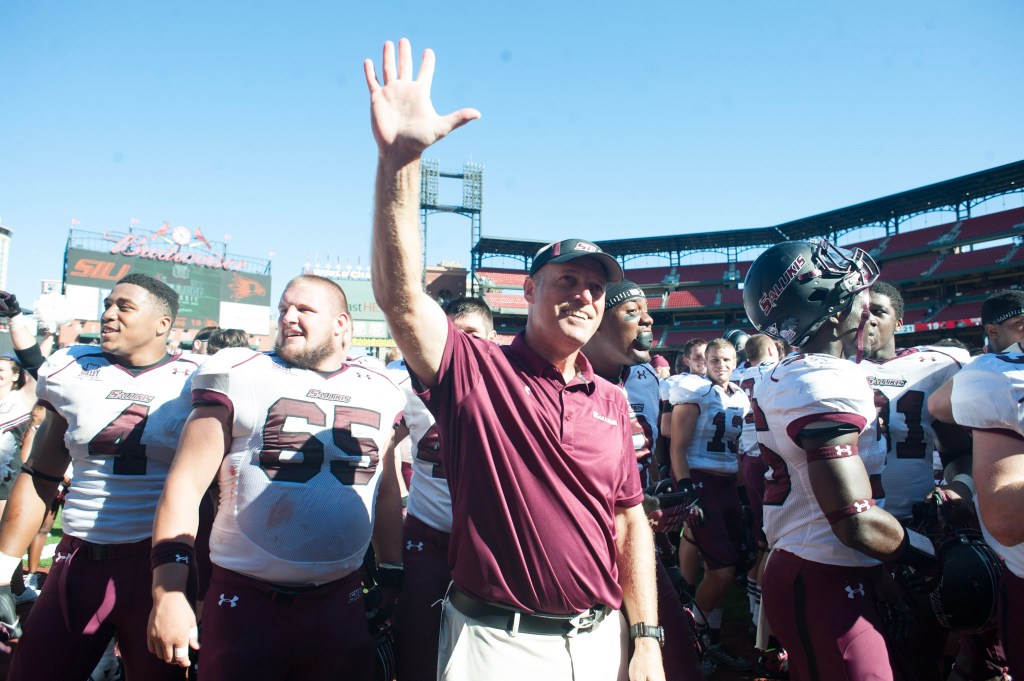
“I remember going out to the field after that summer press introduction. I stepped on the grass and a groundsperson told me to get off,” Lennon said. “That gave me a little concern about how protective they were of the grass.”
Lennon’s short summer walk paid off on game day.
“That (turf) became a concern of ours. Since the field was so well manicured, it was like a fairway on a golf course with a lot of sand on it. Beautiful, but at the same time, not a good surface for playing football. That was our biggest concern going into the game,” he said.
Like any good coach, Lennon got input from his assistants and players.
“We didn’t get to do a Friday practice like we normally did. We didn’t get on the field until game day,” he said. “During warmups our players were saying they couldn’t get traction. We had brought some shoes along that were more suited for a muddy grass field, and that’s what all of our players ended up switching over to.
“You really had to have your body under control to make a (foot) plant and drive out of it.”
Moccia, a former college baseball player, remembers the same issues.
“It was the worst turf we ever played on, I do remember that. The grass was just coming up in chunks, and immediately after the game the head groundskeeper was out there and I talked to him and they had fresh grass on the way,” he said.
Lennon said, “It was risky. I know Southeast Missouri had a player that had a nasty injury. He broke his leg, most likely from the surface when he planted wrong and then got into a bad position with the contact (of the play).”
Saluki comeback
In addition to the dangerous turf, the Salukis and Redhawks faced another challenge.
“Both teams were on the same sideline, and that’s very unique for college football,” Lennon said. “It did make substituting extremely challenging, especially if you’re on defense and you’re sending players to the far side of the field. That ends up being about a 40- or 50-yard sprint for those athletes just to get into the game.
“We practiced that in the week leading up to the game. It was a challenge for the coaches too, being that far away from the action where you don’t have immediate access to your team since you didn’t have the whole sideline to yourself.”
Playing in a ballpark that had witnessed many late-inning rallies since it opened its gates in 2006, SIU came from behind and pulled away with a 36-19 victory over Southeast Missouri.
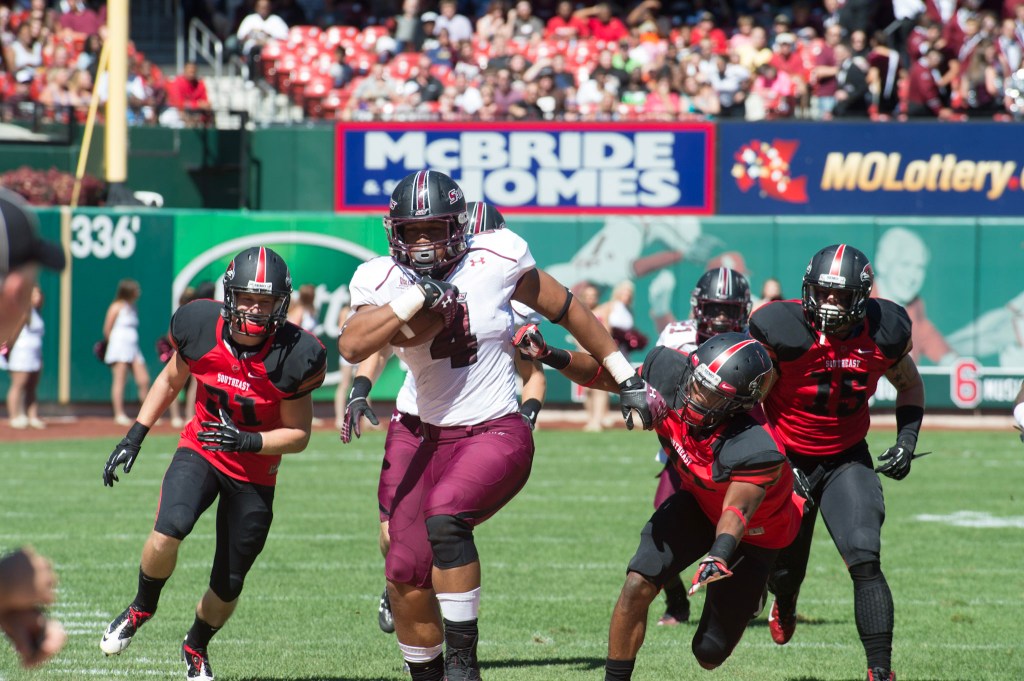
“We played a very good game from start to finish,” Lennon recalled. “It was a very controlling game. Offensively, we had some success running the football. That is what we liked to do. Unfortunately, we gave up a couple of quick scores, so going into the second half it was a close ballgame.
“Coming out of the third quarter, it was anybody’s game. Fortunately, in the fourth quarter we built up a lead that we were able to sustain.”
SIU scored the last 17 points of the game, the two touchdowns coming in the final 15 minutes.
Junior running back Malcolm Agnew carried the ball 23 times for 127 yards, 104 of which came after the half. The Oregon State transfer had one touchdown.
St. Louis native and future NFL tight end MyCole Pruitt caught five passes for 68 yards, including a fourth-quarter touchdown. A two-time consensus first-team All-American, Pruitt later became the Missouri Valley Football Conference record holder in career receptions (211), receiving yards (2,601) and receiving touchdowns (25) among tight ends.
One thing leads to another
In the years that followed, other FCS programs played games in Major League Baseball parks.
Yankee Stadium played host to the 150th meeting of Lafayette and Lehigh in 2014 and another Patriot League matchup, Holy Cross versus Fordham, was played there in 2016.
Fenway Park hosted three games in 2017, including two involving FCS teams, Ivy Leaguers Brown and Dartmouth, on Nov. 10. A day later, Maine from the Colonial Athletic Association took on FBS program UMass.
Jacksonville State, then of the Ohio Valley Conference, and Big South member Kennesaw State met Nov. 17, 2018, in the first college football game played at SunTrust Park, the Atlanta Braves’ new home.
Target Field, home of the Minnesota Twins, has hosted two games. In 2017, a then-record Division III crowd of 37,355 witnessed the University of St. Thomas’ 20-17 victory over in-state rival St. John’s University. The venue then hosted 34,544 fans on Aug. 31, 2019, as North Dakota State downed Butler, 57-10.
Target Field will host its third game this fall. This time around defending FCS national champion South Dakota State is scheduled to play Drake Sept. 16.
Does it work for Illinois?
Given the history and the success of the games in Minnesota, what are the chances a Illinois venue could host a future event?
“I was just talking with a friend about where could you play a neutral site game and who would it be against and all that,” current SIU athletic director Tim Leonard said. “I don’t know what it would cost to put a game on in St. Louis and would there be enough of a draw for that because I’d hate to give up a home game too.”
As with any such decision, there are multiple factors.
“What are your costs going to be to go play it over there? What are your benefits?” Leonard said. “There are some other options out there, I think.”
Would a soccer stadium or a minor league park work?
“Yes, there are those. With Lindenwood now in the OVC, that’s something we could look at, but I don’t want to play the entire OVC in our non-conference. But certainly there are regional teams that we could play there,” Leonard said. “If we’re going to play somebody in St. Louis, it probably wouldn’t be another FCS team. But, maybe there would be enough of a draw for a neutral site game with another FCS opponent, but I don’t know. We’d have to see.”
In 2016, FBS member Northern Illinois gave up a Mid-American Conference home game to play Toledo in the Chicago White Sox park, then called U.S. Celluar Field.
The game was played under the lights on a Tuesday in November, which also happened to be the 2016 presidential election night.
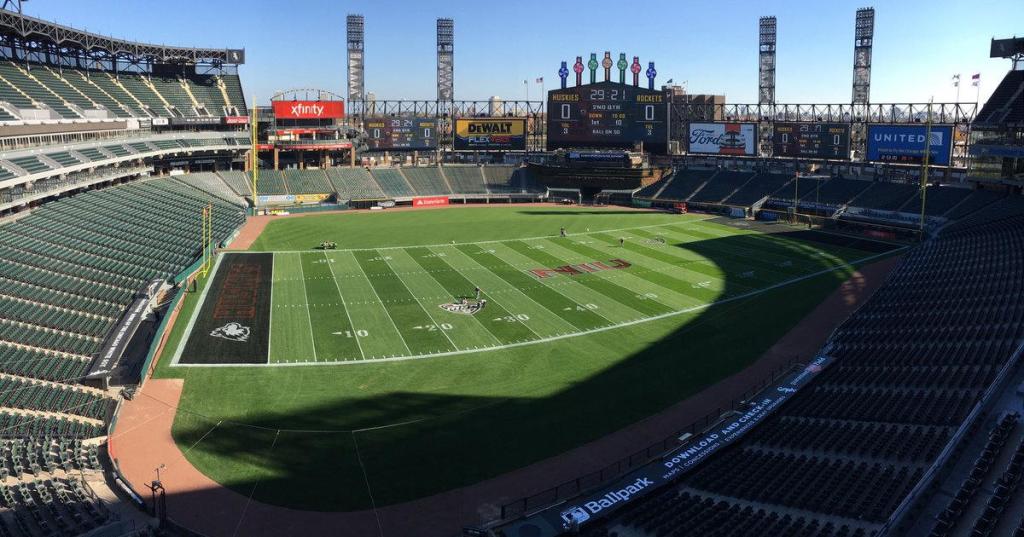
Crain’s Chicago Business reported that the Illinois Sports Facilities Authority, the state agency that owns the 40,615-seat venue, received all parking and concessions revenue and split ticket proceeds above $500,000 with NIU.
Crain’s also reported that the ISFA projected attendance between 15,000 and 25,000.
However, according to the official box score, attendance was 10,180.
While an NIU spokesperson later said, “We got our money’s worth with attention,” the Huskies – and any football team – have yet to play at the ballpark in the seven years since the 31-24 loss.
Prairie State Pigskin contacted the Chicago Cubs, Chicago White Sox, Minnesota Twins and St. Louis Cardinals regarding the logistics and possibilities of hosting future non-baseball events.
Only the White Sox responded, referring us to IFSA CEO Frank Bilecki.
Bilecki, who has held his position for the past two years, said he has “had conversations with a couple of colleges, Big Ten schools, in regard to having games here.”
Bilecki also addressed the challenges, perhaps the biggest of which is planning around the MLB schedule.
“Nothing can really happen until after the playoffs,” Bilecki said. “Really the only month we’re talking about this happening is November. Even if the Sox don’t make it, these schools have to plan out their schedules a year to a year-and-a-half before.”
Then, there are other factors.
“Part of it is just cost. It’s not cheap to have security, food and beverage and everything else that goes into (putting these events on),” Bilecki said. “But, with the right teams, I think the place could be sold out, especially when you look at the dates that I have and the (college) kids are on Thanksgiving break. A decent number of the kids are from the Chicago area.
“I would love to get football here. We still have the goalposts (from the 2016 game). The 100 yards fits within our footprint. We have tailgating and transportation. You’ve got the (CTA) Red Line. You’ve got the Green Line both right here. You’ve got a Metra stop. We’re right off the expressway. It is ideal, not just for concerts, but for a whole slew of things.”
Bilecki was asked if only Big Ten schools would be considered.
“They are some of the closest teams,” he said. “Now, if D3, D2 or some other schools come in and want to have a conversation and come in with a good sales pitch of here’s X, Y and Z of how it can happen, I’m more than happy to entertain any of that.”
Meanwhile, many of the ballparks have hosted a variety of events ranging from boxing to golf to pickle ball – all of which may be easier, cheaper and more profitable than football.
Meet me in St. Louis
Do Moccia and Lennon believe what SIU did 10 years ago is still possible in today’s climate?
“While some things change, and I’m not speaking for (current school administrators), the opportunity to have an athletic event in St. Louis would be interesting,” Moccia said. “I don’t think there was much of a rental (fee in 2013). I know we split the cost and didn’t have to pay for the returfing of the field. I think we each made a modest profit. But it was not some sort of a bellcow from a profit standpoint.
“The Cardinals really wanted to use this as a loss leader, just to go on to bigger events, to say hey, we had a football game here, whether it would be a bowl game or the Mizzou-Illinois game down the road or what have you.”
Lennon has had athletic administrative experience since leaving SIU after the 2015 season.
“I think it’s definitely possible,” he said. “There are a lot of benefits to it, especially in today’s game. Everything is about marketing and how you promote your teams. Playing in a game like that with social media today could be extremely beneficial.
“The experience, and that’s how I think you evaluate whether it was a success of not, was a very positive one. It’s something that our players look back on with pride. I bring it up when I can – hey, I coached a game at Busch Stadium.”
Dan Verdun is a co-founder of Prairie State Pigskin. He has written four books: NIU Huskies Football, EIU Panthers Football, ISU Redbirds Football and SIU Salukis Football.
Find us on social media!
(Twitter: https://twitter.com/PSPigskin
Facebook: Prairie State Pigskin)


Leave a Reply