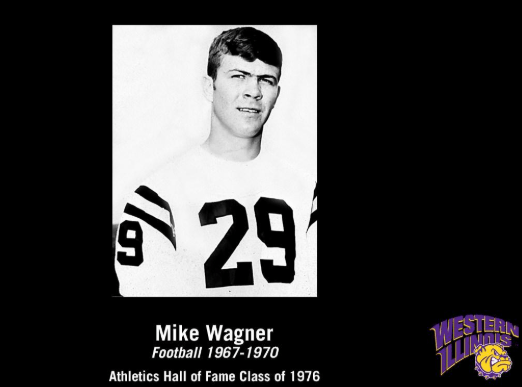
Illinois native Mike Wagner was inducted in the Western Illinois athletics Hall of Fame in 1976. He played a key role in four Super Bowl victories with the Pittsburgh Steelers. (Photo by GoLeathernecks.com)
By Dan Verdun
Western Illinois Hall of Fame member and former Pittsburgh Steelers standout Mike Wagner passed away at age 76 Wednesday from pancreatic cancer, according to multiple news outlets.
Wagner, who played at Western from 1967 to 1970, was inducted into the WIU athletics Hall of Fame in 1976. Playing strong safety, Wagner spent 11 years with the Steelers and was a key figure on four Super Bowl championship teams.
While it may be hard to believe, the Lake Villa native who played prep football at Carmel Catholic High School in Mundelein had to pressure WIU head coach Darrell Mudra into awarding him a scholarship.
“I was not recruited by WIU,” Wagner said in a 2011 interview.
In fact, he had no football scholarship offers at all.
Wagner spent his first two years at Western without any scholarship under then-head coach Art Dufelmeier. When Mudra took over the Leatherneck program in 1969, Wagner decided the time was right.
“Until the beginning of my junior year, WIU did not have athletic scholarships to offer its student-athletes,” Wagner said. “I had to convince Coach Mudra to give me one when Western began funding them.”
Mudra, however, was reluctant.
“He did not want to give me one, saying that I was already there and he could use it to bring another player to the school. I told him my dad was a factory worker raising two more boys behind me and that my mom went to work to help pay for my schooling,” he said.
Wagner said he had to threaten that he would transfer unless Mudra delivered.
“That’s what it took,” he said.
Wagner more than earned it, gaining NAIA All-American honors for the 1969 season.
“Mike Wagner was the All-American boy,” WIU assistant Pete Rodriquez said in 2011. “He was blonde-haired and blue-eyed. He had all the attributes to be a fine player. You don’t find someone like him at Western Illinois usually. He got overlooked by a lot of people and bigger schools. He really blossomed at Western.”
Though he gained his national game as part of Pittsburgh’s “Steel Curtain” defense of the 1970s, Wagner could easily rattle off memories from his days in Macomb.
“I remember getting beat 66-0 by Western Kentucky (in 1968). I remember playing defensive end as a freshman walk-on. I remember the efforts and play of my great teammates that helped me play well enough to get noticed by the NFL,” he said.
Wagner listed a number of Leatherneck teammates and coaches as well as the equipment managers and trainers. He talked of seeing “the fatigue and intensity on the faces in huddles.”
Wagner spoke of the hard work and dedication to transition the Leathernecks from a losing program to the 1969 Interstate Intercollegiate Athletic Conference (IIAC) championship.
“It was a big thing for a small program at the time,” he said.
Wagner said he drew inspiration from Mike Wilson, a four-year WIU safety who received honorable mention All-American status in 1968.
“His success gave me motivation and confidence,” Wagner said.
Wagner remains the WIU record holder in career interception return yardage (343) and single-season interceptions (nine). He is second in career interceptions (15).
His NFL career began when Pittsburgh selected him in the 11th round of the 1971 NFL draft.

Over the course of the next 10 seasons, Wagner was named to four All-Pro teams and earned two Pro Bowl appearances (1975 and 1976) while the Steelers captured four Super Bowl titles.
“From our perspective, we are the standard that others used to determine their position behind us,” he said.
Wagner, who grabbed two key interceptions in Super Bowl wins, credited the Steelers’ leadership.
“A lot of that had to do with (head coach) Chuck Noll and his staff’s stubbornness to stick to fundamentals, to take care of your own responsibility and to make as few mental mistakes as possible,” he said.
“We are deeply saddened by the passing of Mike Wagner, a tremendous player and an integral part of some of the most successful teams in Pittsburgh Steelers history,” team president Art Rooney II said. “As a member of four Super Bowl-winning teams, his toughness and consistency were paramount to our secondary. His contributions on the field were significant, but it was also his steady presence and team-first mentality that truly defined him.”
Wagner finished his pro career with 36 interceptions and 12 fumble recoveries before retiring in 1980. He was ranked the 50th best defensive back by football historian Sean Lahman in the book The Pro Football Historical Abstract, published in 2008.
He was nominated for the Pro Football Hall of Fame in the Seniors category two years ago.
Wagner earned an MBA from the University of Pittsburgh to complement his WIU accounting degree.
“I remember the honor to be called a Leatherneck,” he said, “but in no way do I consider being a WIU Leatherneck anywhere near as brave, tough, dedicated or courageous as the Leathernecks of the United States Marine Corps.”
Dan Verdun is a co-founder of Prairie State Pigskin. He has written four books: NIU Huskies Football, EIU Panthers Football, ISU Redbirds Football and SIU Salukis Football.
Find us on social media!
Twitter: https://twitter.com/PSPigskin
Facebook: Prairie State Pigskin
Instagram: Prairiestatepigskin
Blue Sky: PSPigskin
 Prairie State Pigskin
Leave a comment