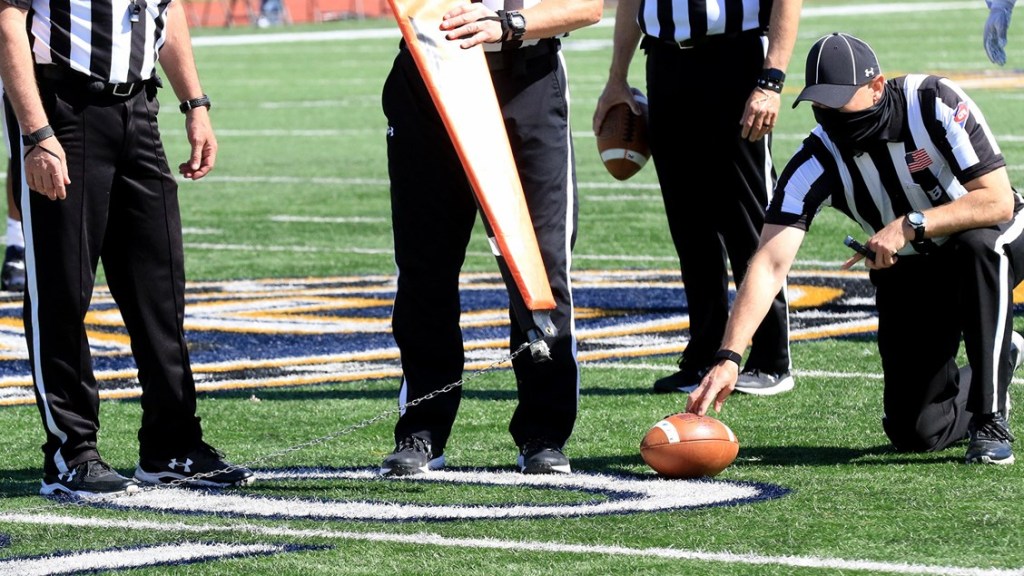
Game officials will enforce rules changes for the upcoming seasons in the OVC-Big South Football Association and Missouri Valley Football Conference this season. (Photo by Ohio Valley Conference)
By Dan Verdun
While several communications rules changes are being implemented for this season, expansion of coach-to-player communication at the FCS level is the most noteworthy.
Used at the FBS level last season, this change allows FCS players to use wearable technologies for in-game calls. This means in-helmet communications will now allow coaches to give direct instructions to one player designated by a green dot on his helmet.
The communication is cut off with 15 seconds left on the play clock or the snap of the ball, whichever comes first.
Given the varying financial expenditures of this rule, it is optional for FCS programs and conferences. Both the Ohio Valley-Big South Football Association and Missouri Valley Football Conference, of which the four Illinois FCS teams are members, have approved the usage, league officials confirmed.
“The player-to-coach thing is huge,” Eastern Illinois head coach Chris Wilkerson said. “We experimented with it during the course of the spring. We only had two of the monitors in the offensive guys’ helmets, so if we had five quarterbacks out here, we only had two wearing it on a daily basis. We rotated it through different guys so everybody had a chance to use it.”

The three other state FCS schools also used the system during spring sessions.
“There’s always things you have to get used to,” Illinois State head coach Brock Spack said. “It’s going to interesting.”
“It even makes practice smoother,” said SIU head coach Nick Hill, a former quarterback. “When you can talk to your quarterback for those 20 seconds between plays, that’s big. It’s a great thing.”
Illinois State and Southern Illinois each return veteran quarterbacks. Both favor the use of technology.
“It’s unique,” ISU senior Tommy Rittenhouse said. “It makes it a lot easier hearing the plays instead of worrying about missing a signal or missing a motion. I hear the play fully and know what to expect and have the picture in my mind. I get up there and read the defense pre-snap and go from there.”
SIU’s D.J. Williams added: “It’s great to be able to understand what your coach is seeing and get some feedback on the field right away.”
Not everyone sees the on-field communication as a game-changer.
While Western Illinois head coach Joe Davis welcomes the opportunity to use the technology, he doesn’t necessarily see it the same way.
“I don’t know that it would change us mechanically a massive amount on offense, but it’s good to have,” Davis said.
Other technology-related rules include:
🏈Teams may use wearable technology, including watches, wristbands and belt-packs for communicating in-game calls.
🏈If more than one green dot helmet is detected on the field, a five-yard penalty will be assessed and the play will be reviewed.
🏈On free kick plays, the helmet communication system will not be active.
Injury timeouts
According to NCAA.org, modifications to injury timeout rules are now in place for the 2025 season.
This rule change is a result of teams having players drop to the ground with “fake injuries” in an attempt to stop the clock or alter the opposition’s momentum.
“Let the players decide the outcome of the game. Let’s keep the game sped up where there are not tons of timeouts,” Hill said.
Under the new rule, if the player “presents as injured after the ball is spotted by the officiating crew for the next play, that player’s team will be charged a timeout,” the NCAA says.
If the team does not have any timeouts remaining, a five-yard delay of game penalty will be assessed.
Illegal defensive substitutions
A potential game-changing rules adjustment is a tweak to defensive substitutions.
“The rule that no one has really talked about that I like is the illegal substitution rule on defense,” Davis said. “With under two minutes (left on the clock), if the defense plays with 12 guys, the offense can put time back on the clock.
“If the defense with 12 players is running off the field, it’s a regular substitution then it’s a five-yard penalty. I like the clock aspect.”
The official NCAA explanation of the change states: “After the two-minute timeout in either half, if the defense commits a foul with 12 or more players on the field and all the players participate in the play, the officials will administer a five-yard penalty. The offensive team would have the option to reset the game clock back to the time at the start of the play. If the 12th player is attempting to leave the field and has no influence on the play, the defensive team will be penalized 5 yards with no adjustment to the game clock.”
Overtime timeouts
If a game reaches a third overtime, each team will have one timeout beginning with the third OT until the game is concluded.
Previously, teams were granted one timeout for each overtime period. Should games reach a third overtime, teams alternate running two-point plays until a winner is decided.
Other rules changes
According to NCAA.org, the NCAA Playing Rules Oversight Panel also approved these changes:
🏈When the decision on instant replay is announced, the referee will only say that the call on the field is “upheld” or “overturned.” The terms “confirmed” and “stands” will not be used.
🏈No offensive player can be in the direct line of the snap to the potential kicker or within the frame of the snapper on punts for the formation to qualify as a scrimmage kick formation. If a team is not in scrimmage kick formation, they must have five players numbered 50–79 on the line of scrimmage. Also, if the snapper is on the end of the line by formation, the snapper will lose scrimmage kick protection, and the opposition can line a player over the snapper.
🏈If any player on a kickoff-return team makes a “T” signal with his arms during the kick, they give up their right to make a return, and the play will be whistled dead.
🏈Enhanced rules regarding simulating action at the snap — along with words or signals that distract opponents when they are preparing to put the ball in play — will also be effective next season. No player can call defensive signals that simulate the sound or cadence of the offensive signals. The defensive terms “move” and “stem” would be reserved for players on that side of the ball and could not be used by the offense.
Dan Verdun is a co-founder of Prairie State Pigskin. He has written four books: NIU Huskies Football, EIU Panthers Football, ISU Redbirds Football and SIU Salukis Football.
Find us on social media!
Twitter: https://twitter.com/PSPigskin
Facebook: Prairie State Pigskin
Instagram: Prairiestatepigskin
Blue Sky: PSPigskin
 Prairie State Pigskin
Leave a comment