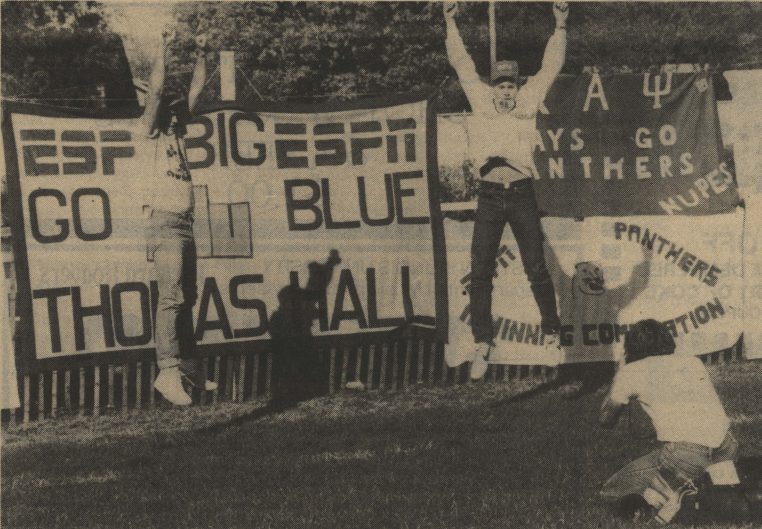
The Eastern Illinois University athletic department staged a “Make Believe We Are On National Television and Banner Contest Day” that drew nationwide attention in 1985. (Photo by Daily Eastern News)
By Dan Verdun
Nearly four decades ago, Eastern Illinois hosted rival Western Illinois in an ESPN game. Well, not exactly.
On Oct. 26, 1985, EIU staged a “Make Believe We Are On National Television and Banner Contest Day” that drew nationwide attention.
“I thought everything went great,” EIU promotions director John Seketa told Jeff Long of The Daily Eastern News afterward.
Thirty-nine years later, Seketa still feels the same way.
“We got a lot out of that,” he told Prairie State Pigskin.
EIU certainly did. The ploy brought coverage from newspapers across the nation including The New York Times, Chicago Tribune, Fort Worth (Texas) Morning Star-Telegram, Louisville Courier-Journal, Jacksonville (Fla.) Times-Union and others.
ESPN anchors Tom Mees and Greg Gumbel interacted over game highlights during an actual “SportsCenter” broadcast.
Mees, a University of Delaware graduate, mentioned that Eastern had defeated the Blue Hens, 10-9, to win the 1978 Division II national championship.
“Gumbel said, ‘Oh, give them props, they’re (EIU) the home of the St. Louis (football) Cardinals’ training camp,’” Seketa recalled.
Anatomy of an idea
Seketa grew up in Benld, Ill., a small town located in the Metro-East portion of St. Louis. He earned his undergraduate degree in marketing from Southern Illinois University-Edwardsville.
After doing his graduate work at Western Illinois University, Seketa interned at the University of Illinois.
The 26-year-old Seketa was then hired as promotions director under the guidance of EIU athletic director R.C. Johnson.
“We had so much fun back then,” Seketa said. “R.C. put his feet up on the desk and said, ‘What did you guys at Illinois do? All you guys at Illinois know everything.’ He would kid us about that all the time.”
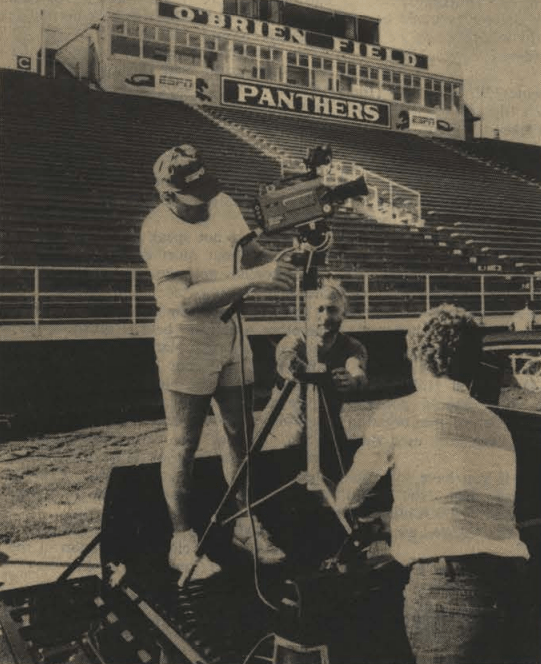
Seketa’s creative skills soon came up with the brainstorm.
Three years earlier, an antitrust lawsuit against the NCAA over college football television rights allowed schools and athletic conferences to negotiate their own TV contracts.
As a result, larger schools dominated the airwaves, essentially ending regional broadcasts for programs the likes of EIU and WIU.
“Back in the day the smaller schools were getting cut out. There were no more I-AA (now FCS) schools on TV,” Seketa said. “Somehow it just popped in my head. Create a make believe game.”
Thus, he set about calling the major networks of the era – CBS, NBC, ABC.
“They weren’t interested,” Seketa said. “Finally, an ABC rep said, ‘Call ESPN. They’re new. They’ll do it.’”
ESPN’s Mike Soltys told the Charleston Times-Courier, “Ordinarily we wouldn’t be interested in something like this, but since it is unique we are going along with it.”
Seketa said that the then-six-year-old sports station shipped ESPN caps, t-shirts and banners to him for the event.
Soltys mailed out a college football release that included information about the promotion to the likes of The Sporting News and Sports Illustrated.
The release included tongue-in-cheek “comments” from ESPN football analyst Paul Maguire centering on being upset that he had to settle for covering a Tennessee-Georgia Tech matchup rather than the EIU-WIU showdown at O’Brien Stadium.
“This is what I’ve been thinking about ever since BYU lost,” Maguire said. “I think (EIU quarterback) Sean Payton is better than (BYU QB) Robbie Bosco. I’m voting for him for the Heisman.”
How it played out
Seketa and a small crew transformed his dream into a reality.
“It was just (graduate assistant) Paul Lueken and me and a couple students. We made it work,” he said.
EIU’s audio visual department provided a camera for the day. The operator was decked out in an ESPN shirt and cap. A satellite dish was placed in the stadium parking lot.
Banners were placed in the end zone so “viewers” nationwide would see them.
According to published reports, the banner contest drew 32 entries with the designers of the most creative winning ESPN hats.
EIU public address announcer Matt Pieczynski revved up the crowd of an estimated 7,000 spectators by saying, “In 10 seconds, ESPN will be joining us live, so let’s give them a big welcome!”
Not all sunshine, balloons and banners
The event did meet with some disappointment.
“There was a photographer from Sports Illustrated,” Seketa said. “I had visions of making it into the magazine.
“Well, guess what happens?!? The darn Cardinals and Royals make the World Series (bumping a potential story and photo). That was my chance to be in Sports Illustrated,” he said with a laugh.
Then there was the game.
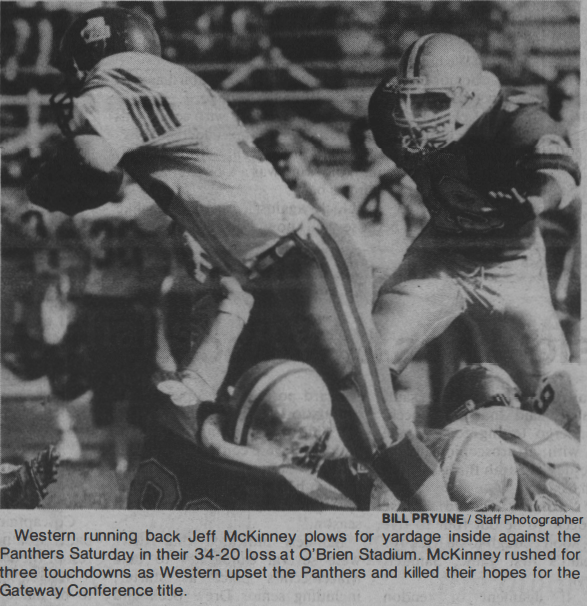
Western throttled Eastern, 34-20, in the inaugural season of the Gateway Athletic Conference. The league would later evolve into the Missouri Valley Football Conference.
“I remember feeling honored to beat All-American QB Sean Payton and EIU that year, and proving to myself and others that I could be a successful college QB,” Western freshman Paul Singer said.
The following season, Payton and the Panthers breezed to a 37-3 win at Macomb’s Hanson Field. EIU won the Gateway championship and advanced into the quarterfinal round of the playoffs as Payton was named the league’s player of the year.
Singer went on to win the award in 1988, leading Western to the Gateway crown and a playoff berth.
Lueken later became the longest tenured athletic director in Division II Slippery Rock (Pa.) history. After serving in that capacity from 1994 through 2021, the Marshall, Ill., native was inducted into the school’s hall of fame.
Seketa spent only one year at Eastern. He landed a position at Clemson University in South Carolina, where he spent the next 26 years.
“I was in charge of all sports here,” he said. “Now we have an army of people doing what I did. I was also in charge of the mascots. So I wrote a book (about the Clemson Tiger mascot). I’ve done four editions of it.”
Now retired, Seketa heads up the Clemson Eight Challenge, a week-long event to honor eight Tiger alumni who participated in the infamous Bataan Death March early in World War II.
“This is a big military school here at Clemson,” he said. “We’re up to a $113,000 endowment. Hopefully we’ll get up to $200,000 to $300,000 in a couple years.”
‘It would still be a good promotion today’
Despite all he has accomplished in his career, Seketa still looks fondly back on that October afternoon in 1985 when he brought national attention to EIU.
“It made all the newspapers from coast to coast,” he said. “It was the right timing for what turned out to be a good idea.”
And Seketa believes there’s still a place for such events in contemporary collegiate athletics.
“It would still be a good promotion today,” he said. “(The FCS) schools don’t get on the ‘big’ TV anymore. What’s the chance of Eastern being on TV unless they play Illinois? I was at the Western game at Indiana this year. I’ve gone to those games (that usually turn out to be a one-sided payday).
“There’s still a place for the things that we did.”
Dan Verdun is a co-founder of Prairie State Pigskin. He has written four books: NIU Huskies Football, EIU Panthers Football, ISU Redbirds Football and SIU Salukis Football.
Find us on social media!
Twitter: https://twitter.com/PSPigskin
Facebook: Prairie State Pigskin
Instagram: Prairiestatepigskin
 Prairie State Pigskin
Leave a comment