Hunter Simmons (18) will make his first career start for Southern Illinois as quarterback D.J. Williams (2) will miss significant time with a hand injury suffered in Saturday’s win against Incarnate Word. (Photo by Saluki Communications)
By Dan Verdun
Injuries have been a part of football since the game began over a century and a half ago.
However, those injuries have seemed to hit even harder in the first three weeks of this season than in recent memory.
This past weekend, Southern Illinois was dealt a severe blow when starting quarterback D.J. Williams, a transfer from Murray State, sustained a hand injury. SIU head coach Nick Hill announced Tuesday that Williams would have surgery the following day.

While Hill added there is “a chance we get him back at some point this year,” recovery and rehabilitation is an unknown timeline.
Redshirt junior Hunter Simmons will make his first career start Saturday against regional rival Southeast Missouri, Hill said.
Meanwhile, things are anything but the status quo in Normal.
Longtime Illinois State head coach Brock Spack has seen more than his share of injuries during the first quarter of the Redbirds’ fall schedule.
To date, ISU has lost three key stars and had a fourth has been slowed by injury.
That list includes running back Mason King and offensive lineman Hunter Zambrano, both who are out for the season. In addition, linebacker Amir Abdullah is “week-to-week,” while receiver Daniel Sobkowicz “has been slowed” by a variety of ailments, according to Spack.
“Those guys are All-Americans,” Spack said, in reference to all four landing on PhilSteele.com preseason All-American teams.
While the Salukis and Redbirds, both nationally ranked, have been hit in key spots, Eastern Illinois is “in pretty good shape (overall) thus far,” according to head coach Chris Wilkerson.
What makes that perhaps more interesting is that EIU has played two Big Ten Conference opponents in its first three games.
“We’ve got some guys who have bumps and bruises, but you’d have that after three games no matter who you play this time of year,” Wilkerson said. “But at this time, nothing catastrophic (injury-wise).”
Injuries now and then
As all three head coaches know, injuries can come at any time and in a variety of ways.
While many of the rules changes in recent years have been designed with player safety in mind, the game still remains dangerous and violent at its core.
“I still think it’s probably the nature of the game,” Wilkerson said.
Spack was a linebacker at Purdue in the early 1980s. Wilkerson was a defensive lineman at Eastern in the early 1990s. Hill played quarterback at SIU in the mid-2000s.
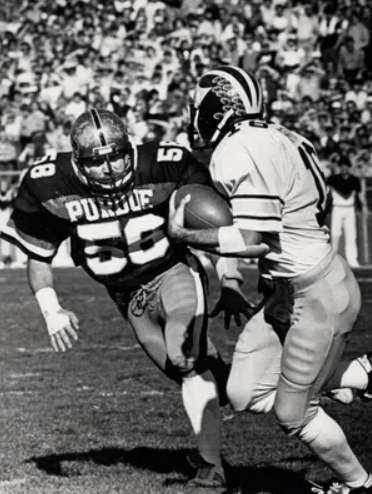
“When I played, we probably learned it wasn’t the right thing to do (to continue playing while hurt),” Spack said. “I’ve had five surgeries after (the age of) 50. It is what it is. I’d do it again, but I’d try to do it longer and better. I loved every minute of it.”
Despite his passion for the game, the 62-year-old Spack supports the recent changes in the name of player safety.
“Sports medicine has gotten to the point where they’re going to protect the player. That’s what they’re going to do and should do,” he said.
Spack recruited Wilkerson to Eastern when the now-ISU head coach was an EIU assistant under Bob Spoo in 1990.
The two square off at 6 p.m. Saturday at Hancock Stadium when Illinois State hosts Eastern Illinois in the annual “Mid-America Classic.”
Both men have coached their sons on the collegiate level. That fact, no doubt, has also influenced their thinking about player health and safety.
Spack’s son Brent was a Redbird linebacker from 2012 to 2016. Wilkerson’s son Peyton is a redshirt freshman defensive lineman on the current EIU roster.
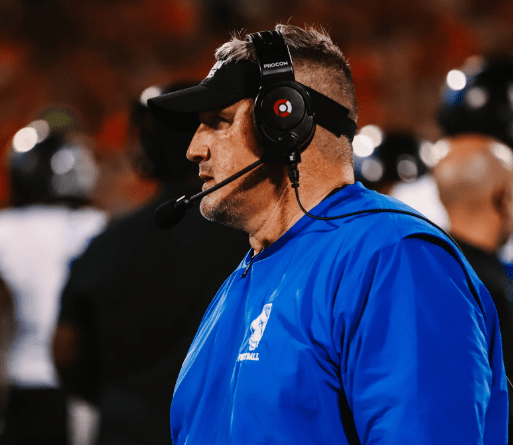
Certainly, both head coaches see the value in change.
“One thing (from when I played) is the sports medicine world has changed quite a bit,” Spack said. “When I played there was no sitting out on certain things that they do (these days). Now, you have to be (medically) cleared to play. We listen to our medical experts.
“(It’s about) protecting players. There is a life after football.”
Along with progress in sports medicine, Wilkerson touched on the growth in other areas.
“You’ve got to try to modify things and evolve in terms of the way that we practice and what we do from a strength and conditioning standpoint and a prehab standpoint with our athletic training staff and what we provide,” he said.
Rhyme ‘n reason
Injuries, however, still occur despite advances in training methods, equipment innovations, improved nutrition and modern sports medicine.
Again, there are a myriad of reasons behind this.
“They’re physical players,” Spack said. “They’re big and fast. They’re in the weight room a lot. We were in the weight room too, but it’s different (now).”
In the 1980s, for example, the average NFL offensive lineman was the same size as today’s defensive ends, 6-foot-4 and 272 pounds.
Additionally, today’s defensive ends are much faster than those of yesteryear.
Wilkerson points out that today’s player sees much more action before enrolling in college.
“I do think the student-athletes have played a lot more by the time we get them,” he said. “They play two or three sports year-round and travel (team) things. Their bodies are a little bit more worn down or beat down before they get to the intercollegiate level.”
Depth matters
While FBS programs have 85 scholarships available, FCS teams get 63.
“We continue to try to maintain our health, and if not, the next person needs to step up and that continues to happen for us every single week, every single practice,” Wilkerson said.
While Hill expressed confidence in Simmons, a player who has spent four years in the Saluki program, SIU will miss the dual-threat Williams.
Before leaving last weekend’s 35-28 win against a nationally ranked opponent, Williams passed for 301 yards and two touchdowns while rushing for 79 yards and a 28-yard touchdown. He was named Missouri Valley Football Conference Offensive Player of the Week.
Yet, knowing the unpredictable world of college football, Hill had a plan.
“I’m talking to every player on our team,” the ninth-year SIU head coach said. “Every player on our roster has a role, and they’re going to be called upon at some point this season.
“We’ve seen that. Guys come into the season that didn’t think they’d be playing in the first three weeks (and are) now out there playing.”
The way this season seems to be going, that’s a fact more than ever.
Dan Verdun is a co-founder of Prairie State Pigskin. He has written four books: NIU Huskies Football, EIU Panthers Football, ISU Redbirds Football and SIU Salukis Football.
Find us on social media!
Twitter: https://twitter.com/PSPigskin
Facebook: Prairie State Pigskin
Instagram: Prairiestatepigskin
 Prairie State Pigskin
Leave a comment