
Being in Carbondale has felt like “home” to Iowa native and Saluki offensive lineman Noah Fenske (53), who waited more than a year to play because of NCAA eligibility rulings. (Photo by SIUSalukis.com)
By Barry Bottino
When Noah Fenske and his older brother, Josh, came to Carbondale on a recruiting visit, they ran into an unexpected delay.
“We ran out of gas on the way here,” Noah Fenske said with a laugh. “(Josh’s) car has a weird gauge that said he had a quarter-tank left. We ended up having to call a tow truck and get gas from the tow truck guy. It was the most expensive tank of gas we’ve ever bought.”
Long before Fenske put on an SIU uniform Saturday night and started at offensive tackle for the Salukis in their season opener against BYU, delays became all too familiar in his career.
For months after he signed with the Salukis in December 2022, SIU submitted a waiver and two appeals to the NCAA on behalf of Fenske, who began his college career at Iowa, transferred to Colorado, then left Boulder amid the massive roster purge created by the hiring of Buffaloes head coach Deion Sanders.
“It’s all I’ve been thinking about, going out and balling out,” said Fenske, who eventually was ruled ineligible last season.
Throughout the 2023 season, Fenske waited, and waited, and waited some more, along with head coach Nick Hill and offensive line coach Dan Clark, for a response from the NCAA.
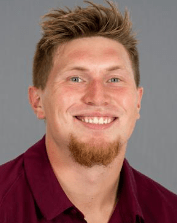
“I thought they handled it really immaturely,” Fenske said of the NCAA process. “Our waiver was something like 35 pages, with countless (pieces of) evidence. There was never a conversation. If you say you’re going to get back to me in four weeks, 80 or 90 days is really unacceptable.”
Fenske, meanwhile, has impressed coaches and staff with how he handled the ups and downs of the situation.
“You could really have a victim type mindset of that’s not fair,” Hill said. “We talked a lot about the reasoning why things happen. A lot of his situations, he’s not been in control of, and how he’s handled it has been impressive.”
Fighting for Fenske
Former SIU golfer Molly Hudgins was the deputy athletic director for administration and student services when Fenske joined the SIU program. Now the executive director the SIU Alumni Association, Hudgins has vivid memories of the process during a wave of two-time transfer requests across the country and potential shifts in NCAA eligibility rules.
“My role in Noah’s case really started as Coach Hill was recruiting Noah,” Hudgins said. “The first part of my job with Coach Hill was just to manage expectations. I told him there’s a chance he doesn’t see the football field (for a year).
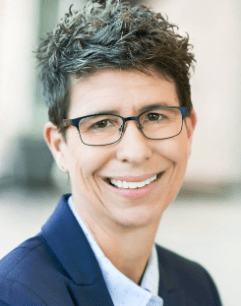
“The more I got to know Noah, the more I really thought that this isn’t just a case of a kid who is a two-time transfer,” Hudgins said. “This is a case of a kid who without a doubt meets transfer exceptions because of what he’s been through at Iowa, what’s he’s been through at Colorado and what he’s been through in his whole life.
“If there’s ever a case for that mental health exception, he meets it.”
The 24-year-old Fenske said his mental health struggles began as a teenager and led to some difficult times.
“I wouldn’t say I had the hardest childhood, but I had a tough childhood at times,” he said. “That’s not a woe is me. It’s made me who I am today. I had a couple bad years there in my early 20s.”
Fenske has met with a psychologist “for years,” including one since he arrived at SIU.
“I really feel like I’ve found a home here. Being settled here, my mental health has gotten a lot better,” he said.
From Iowa City to Boulder to Carbondale
Fenske was a highly recruited lineman out of Iowa’s New Hampton High School, about 120 miles north of Iowa City.
He redshirted in 2019 and played in one game the following year for the Hawkeyes. Though he was climbing the Hawkeyes’ depth chart, he struggled off the field, Fenske explained to Salukis broadcaster Luke Martin in an episode of the Saluki Royalty podcast.
Despite the difficulties he experienced there, Fenske told Prairie State Pigskin that he appreciated the efforts of Iowa head coach Kirk Ferentz and the school’s support staff.
“In Iowa City, there was a really good sports psychiatrist,” he said. “It was hard for me to translate it into practice. I don’t want to bash Iowa. Coach Ferentz reached out for me a lot both times I was in the portal.
“Iowa City just was not a good place for my mental health,” he said. “They did the best that they could. The help just wasn’t working for me.”
At Colorado, he played in seven games over two seasons, including one start at center while playing for multiple position coaches. Fenske said he found mental health resources difficult to access and ran into issues with his health insurance.
Then, there was the infamous introductory Sanders press conference, in which the coach said he was bringing his own “luggage” to Boulder, a signal to dozens of Colorado players, including Fenske, that they were no longer welcome.
When he arrived in Carbondale, Fenske found a welcoming staff, including a familiar face in Hill. The Fenske family has known Hill for years, in fact. Hill’s brother-in-law coached Fenske in basketball in Iowa. Hill and SIU also recruited Josh, who committed to the Salukis before eventually deciding to stay closer to home at South Dakota State, where he began his career in 2018.
“They’re a bunch of people who genuinely care about each player,” Noah Fenske said. “Mentally, I’ve been better because of that.”
Along with Hill, Fenske said he often leans on Clark as well.
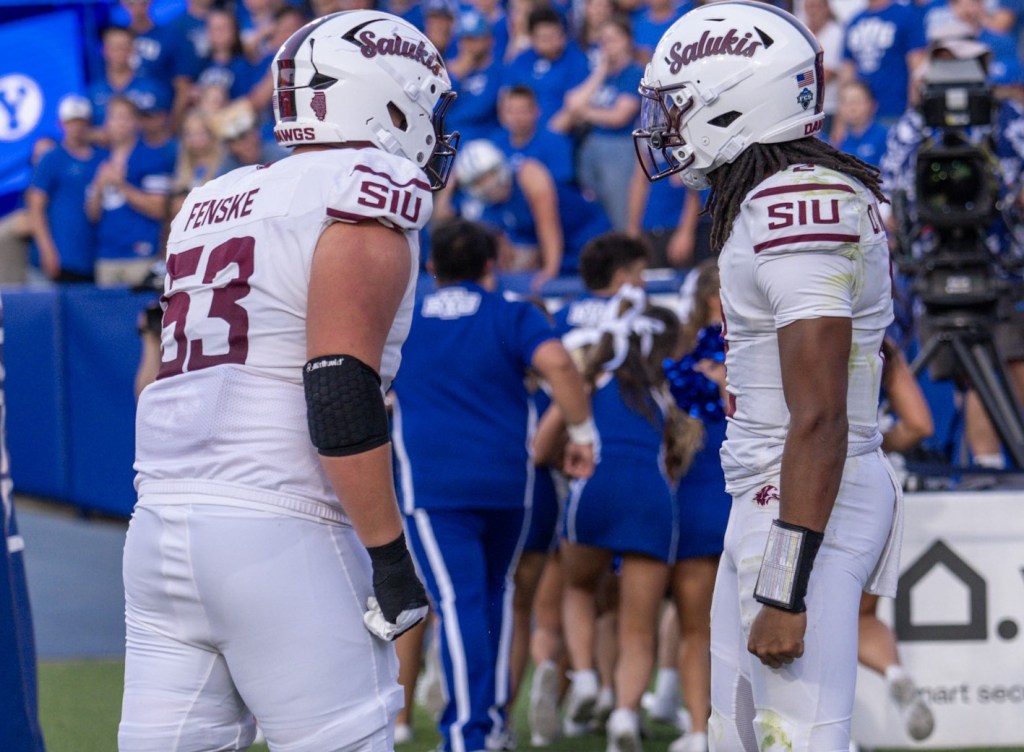
“Coach Clark has been one of my best resources when it comes to, ‘Hey, I just need to vent about something. I can vent about him sometimes to him,’” he said. “I have a coaching staff here that if I have an issue, I don’t have to be scared to tell anyone. I feel like I made the wrong decision to go to Colorado, but I made the right decision to come here.”
He spent last season helping Clark and his teammates in practice and during games, where he was an extra set of eyes.
“I was trying to help the team win and doing anything I could,” Fenske said. “I would help Coach Clark identify (defensive) fronts during the games, talk to guys about different things they’re doing, things I’m noticing.”
Meanwhile, he raised some eyebrows in the weight room, gaining more than 100 pounds on his bench press to more than 465. In July, he shared a video from the SIU weight room of teammates celebrating while he squatted 700 pounds.
He attributes the gains to “having a support staff that makes me want to be the best version of myself.”
NCAA rollercoaster ride
When Hudgins first put the waiver case together, she had high hopes.
“I really thought the case we put together initially was one the committee would look at and make him eligible before the football season started,” she said. “I feel like he got a raw deal. There were so many cases that hit the system at that time. There was an inundation of situations that the NCAA, for lack of a better description, put the hammer down.
“I think he was a victim of consequences at that point.”
Like Fenske, Hudgins grew frustrated by the timing of the decision.
“We had all this information into the NCAA before the summer. We didn’t hear anything back until the football season had already started,” she said. “That’s just wrong.”
After an initial appeal, the NCAA asked a few questions, and SIU prepared more evidence and hoped for an approval. Instead, they were dashed once again.
On Oct. 17, 2023, Fenske posted a message on Twitter that he was officially denied eligibility.
“It was a really difficult conversation to have to call Noah and Coach Hill and Coach Clark and say, ‘I don’t know what else we can do,’” Hudgins said. “I think I lived and died with them.”
Throughout the process of gathering evidence for his case, Fenske and Hudgins had numerous personal conversations about his upbringing and mental health struggles.
“He had to tell me a lot of things that he probably hasn’t had to tell a lot of other people,”
Hudgins said. “I feel really fortunate that I got to know Noah Fenske the way I have.”
Bringing up those struggles once again involved mixed emotions for Fenske.
“There was definitely some worry about opening up these things again,” he said. “But there was some power to it. I got through that. I’m here and I’m a better person because of it. I’ve grown a ton through this process.”
In that Twitter post, Fenske expressed his appreciation for Hudgins and her impact on his time at SIU.
“I have a ton of respect for Molly and I’m forever grateful,” he told Prairie State Pigksin. “I know she gave everything to it. It was really hard.”
Fenske’s words still resonate with Hudgins today, even in her new role.
“It meant the world to me,” she said. “That’s why you go to work on a college campus, to impact lives and hopefully help people.
“I’m his biggest cheerleader,” she said. “I’m excited to see him play. I’ll wear his jersey all day. Noah has a great story, and I feel like his story is going to be even greater (this fall). He’s going to be a heck of a Saluki football player.”
Fenske’s debut was a big moment for Hill as well.
“I was proud to see him trot out there on the field for a lot of different reasons,” he said. “No. 1, because he’s a really good player. But it’s more than that.”
One big step for athletes
While the disappointment in the NCAA’s decision still lingered, Fenske decided to make an impact on current and future athletes.
He submitted an affidavit in Ohio vs. the NCAA, which challenged the ineligibility of two-time transfers and involved six states, including Illinois.
“Noah didn’t have anything to gain because he was going to be eligible (in 2024) anyway. But he chose to give an affidavit for that case,” Hudgins said. “He chose to tell what impact it had on him that he didn’t get to play. He stepped up in a big way.”
In December 2023, a federal judge in West Virginia issued a temporary restraining order that allowed immediate eligibility for athletes who were forced to sit out as two-time transfers.
The impact of that decision was felt just steps away from Saluki Stadium.
“He helped one of our basketball players, Jarrett Hensley, get eligible,” Hudgins said. Hensley, a transfer from the University of Cincinnati, played in 23 games last season for the Salukis.
“I didn’t want anyone to go through what I had to go through,” Fenske said. “For student-athletes to not be able to transfer can be pretty cruel, especially given certain situations.
“It does not help to transfer twice. If I can go back and do it over again, I wouldn’t have transferred twice. It’s not what I wanted to do. I don’t feel like I, or anyone else, should be punished for it.
“In a sense, (the opportunity) to get back some of what was taken from me and give it somebody else, that was really important,” Fenske said.
In April, the NCAA aligned itself with a court order and adjusted its rules so athletes will be immediately eligible no matter how many times they transfer. This was equivalent to a massive shift in NCAA policy.
And it made Fenske a small part of the gigantic change.
“When he gave that affidavit, I don’t know if he knew how landmark of a situation that would be,” Hudgins said. “I’m not sure I knew how landmark of a situation it would be.”
Barry Bottino is a co-founder of Prairie State Pigskin and a 19-year veteran of three Illinois newspapers. He has covered college athletics since 1995.
Find us on social media!
Twitter/X: https://twitter.com/PSPigskin
Facebook: Prairie State Pigskin
Instagram: Prairiestatepigskin
 Prairie State Pigskin
Leave a comment