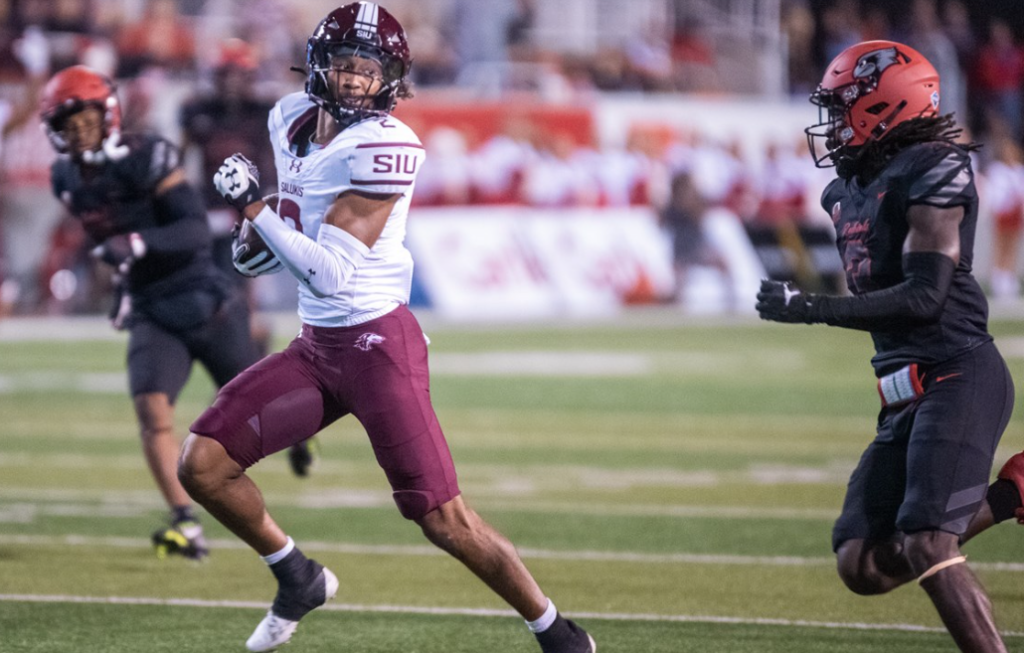
Charter members Illinois State and Southern Illinois, along with the rest of the MVFC, face unprecedented challenges in the ever-changing world of college football. (Photo by Valley-Football.org)
By Dan Verdun
The college football landscape is ever changing. Recent years have brought the transfer portal; Name, Image and Likeness (NIL); and conference realignment to the forefront.
Add these to the uncertainty of how many levels of Division I college football will exist when the dust settles and fallout from the recent House vs. NCAA settlement.
The NCAA’s national office reportedly will foot the bill for a $2.7 billion payment over the next 10 years for past damages. The NCAA would generate the majority of that money by slicing the funds it distributes annually to D-I schools.
All of this presents real and present challenges facing the Missouri Valley Football Conference.
“The short answer for the challenges is the national collegiate landscape is something we don’t control. We’re looking at a House settlement that is going to impact our member institutions,” MVFC commissioner Patty Viverito told Prairie State Pigskin.
Viverito further explained those obstacles.

“Of course, the Missouri Valley Football Conference is a single-sport league and (therefore) doesn’t get any NCAA revenues (from the NCAA men’s basketball tournament),” she said. “Regardless, our member institutions are going to be asked to pick up a good portion of that settlement cost. That’s very challenging for all of us, at every level.”
Yet Viverito, who has been the MVFC commissioner since its inception as the Gateway College Athletic Conference in 1985, sees a silver lining among the looming storm clouds.
“In terms of opportunities, ours have really been pretty consistent really since the mid-’90s. That has allowed us to be competitive at the highest level as offered by the NCAA and we want to succeed in the FCS playoffs,” Viverito said. “We’ve been able to do that because our (university) presidents have committed to that. And, of course, we have athletic directors and head coaches that make that happen. We’ve been pretty successful in achieving those opportunities.
“I think you can count on the membership of the Missouri Valley Football Conference figuring out a succession plan that keeps us focused on our continued success at the highest level within the NCAA.”
North Dakota was added to the MVFC in 2020. Murray State joined in 2023. Charter member Western Illinois left following last season for the Ohio Valley Conference. This spring Missouri State, another charter program, announced it had accepted an invitation to join FBS Conference USA, beginning with the 2025-26 academic year.
While Viverito has talked about that uncertainty and potential impacts on the league at length, Prairie State Pigskin contacted seven media members who have a history covering the MVFC. We asked each a series of questions about where the league stands and where it might be heading.
These are the four who replied:
Jay Elsen, Sioux Falls, S.D.-based broadcaster for Midco Sports, who has been the play-by-play voice for South Dakota football since the Coyotes joined the MVFC in 2012.
Jeff Kolpack, Fargo, N.D.-based journalist for Forum Communications, who is the beat writer for North Dakota State football.
Luke Martin, the play-by-play voice of Southern Illinois football. He has covered the MVFC since 2016, including spending five seasons as Indiana State’s broadcaster.
Wyatt Wheeler, Springfield, Mo.-based writer who has covered Missouri State athletics since 2016. He is a central Illinois native who grew up going to Illinois State athletic events.
1. Have any of the recent additions or subtractions to the MVFC surprised you? Why or why not?
Elsen: I was honestly surprised by the addition of Murray State from a football perspective. While I do think the Racers were a slight overall upgrade over Western Illinois, that felt like a basketball-driven decision. I did ask Commissioner Viverito about that during last year’s MVFC Media Day. She indicated that all potential expansion candidates were considered holistically, but I remain unconvinced in that particular case.
What will really be interesting moving forward is seeing what happens with schools that have rumored to be considering the FBS move. Obviously Missouri State has already made its decision, but what happens with perennial MVFC and FCS heavyweights North Dakota State and South Dakota State? Those decisions, in my opinion, will have a much greater impact on the future of this league and the FCS in general.
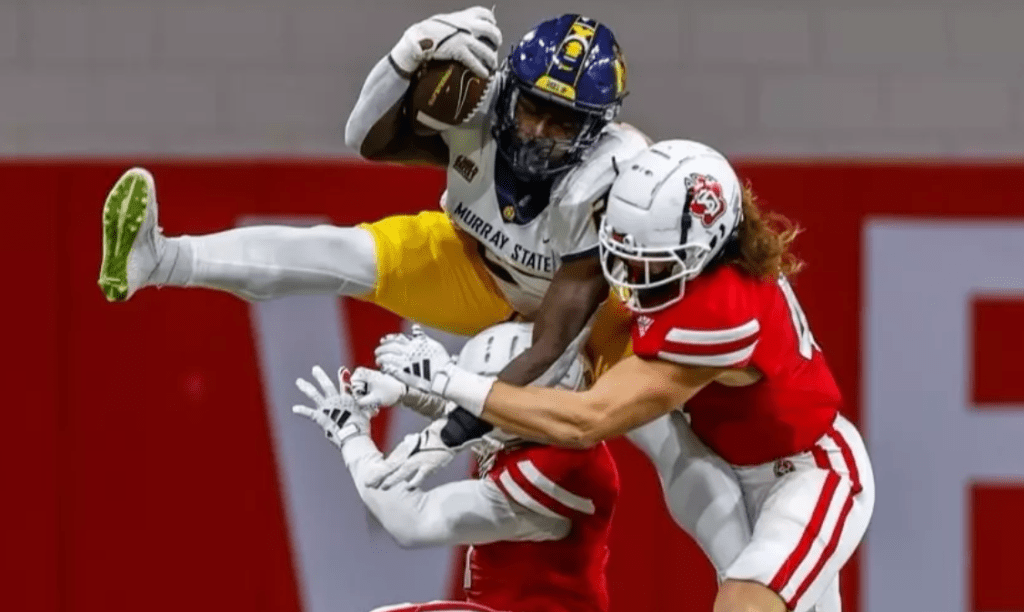
Kolpack: Surprised? More like not in favor. I don’t think Murray State is doing the football side any favors, based on past performance, but maybe the Racers will make good on their promise and invest in the program. Missouri State to FBS was a rumor for awhile, but to see it come to reality was a knock on the chin to those schools still in FCS wanting to move up.
Martin: When you look at when the Missouri Valley Football Conference has added teams, it has no question been to the benefit of the Dakota schools. Mostly because all of the additions to the league, until Murray State’s addition, were the four Dakota schools (NDSU, SDSU, USD, and UND).
Adding Murray State made sense for the obvious reasons, as many of the Gateway original schools needed another addition that could help them with travel costs. Murray State was already coming into the Missouri Valley Conference, and the Racers have played MVFC teams frequently in non-conference action. The move made sense, despite it not being popular due to the lack of success on the field for Murray State.
The loss of Missouri State shouldn’t be a shocker to those who have been around. The Bears have been very ambitious in wanting to move up to the FBS level, and a lot like how people viewed Murray State being added to the league with its lack of success, the same has been said for the Bears in moving to the FBS with their lack of success in the FCS landscape.
Western Illinois made the right decision for them, as we all saw it was beyond time for them to transition to another league.
Wheeler: I haven’t been surprised by any of the additions or subtractions. The only real surprise is how the Dakota schools haven’t been touched, but it also makes sense because of their geography and the changes to leagues around those regions.
Covering Missouri State, I’ve had many conversations with administrators over the last several years and they haven’t been shy about their desire to move to an FBS league. When you look at budgets and other numbers that seem to matter in realignment, Missouri State moving on always made sense despite its lack of historical success on the field. When you take that all and add it to the national reporters who cover realignment and collegiate sports on a grand scale, there was no surprise with MSU going to Conference USA after it rebuilt itself into what appears to be a stable league.
Western Illinois also didn’t surprise me considering its lack of success and budget. A move to the Ohio Valley Conference made a ton of sense, and I believe that the MVFC was happy to see WIU go.
2. How do you see the league managing changes over the next few years?
Elsen: All conferences have some sort of plan in place when it comes to expansion and/or detraction, although I’m not sure it’s possible to truly be prepared for the landscape we’re currently experiencing. Commissioners maintain a “short list” of potential expansion candidates, just as ADs do with future coaches.
But there is so much uncertainty and rapid movement right now that it feels like being proactive isn’t necessarily enough. The MVFC has a sterling reputation in the FCS ranks, which is certainly beneficial. But the league is not immune to anything. They will have to adapt, just like everyone else.
Kolpack: There will be a change in the governance when Patty Viverito retires, so that will be something to look for. The key for the league will be hoping more schools don’t bolt for FBS.
Martin: This is where it gets challenging for the MVFC and why leadership is going to be vital to the success of the league. There needs to be a decision as a league of where does this league want to end up? We know the split is coming between the haves and the have nots in college football, as we read about that daily. It is essential for the MVFC to be ready to move into whatever is going to be that second division, right behind the autonomy five.
I know many have made fun of Missouri State wanting to make the jump. Is the timing bad? Maybe, and it could prove to not be smart to make the jump now with everything financial that goes with it, but I do not blame Missouri State for wanting to make sure they can be a part of the next group outside of the biggest level. The league needs to know which teams are serious about being a part of that group and want to push the league to that level.
Wheeler: I’m fascinated to see how it turns out. I’ve been a lifelong fan of the Valley and there are certainly holes that it needs to fill. I think when they replace Missouri State, it’s going to need to be somewhat basketball-centered to get the basketball league back up to 12. The departures of MSU and WIU in the football league brings it back to 10 members, which is doable with scheduling.
The one thing about the Valley’s next wave of realignment that differs from the past is that there’s no clear-cut favorite to join the league like Murray State and Belmont were when they joined the basketball league a few years back with Murray also joining in football. The football league knows it’s going to need to be proactive when the day comes when North Dakota State and South Dakota State inevitably make a jump, although that doesn’t seem to be happening anytime soon. I’m also curious about Illinois State’s future when it has a competitive budget with Group of 5 members and has great facilities.
3. What are the biggest opportunities for the league?
Elsen: In my mind, the MVFC’s greatest opportunity lies within the status quo.
The FCS national champion has come from the Missouri Valley Football Conference in 11 of the last 13 years. The two exceptions in that span (2016, 2020) saw the league produce the runner-up, while on two other occasions (2014, 2022) it actually claimed both spots. The MVFC is the standard.
So while things continue to shift around, and they will, continue emphasizing that unparalleled excellence.
Kolpack: TV is always the operative word when it comes to exposure and opportunities. It will be interesting this year to see if ESPN goes through with its word to put more games on main linear TV channels.
Martin: The best opportunity for this league is to use its success in being attractive for potential schools to want to come be part of this league. It is why I believe it is important for the MVFC to be ready to shift and make positive moves forward in being a serious league in the next tier of college football.
There are many leagues, like the Mid-American Conference, that will want to pretend that they have a legit path to the College Football Playoff. There will come a time where the MVFC needs to be on equal footing with a league like the MAC (Mid-American Conference), Conference USA, etc. The MVFC has shown to have success against MAC schools and can compete with those teams, but which MVFC schools are willing to put in the resources to get to that level?
Wheeler: It’s still the premier FCS conference and it’s still going to have two favorites to win the national championship year after year, until NDSU and SDSU move on. Being able to sell that it’s the best league is still going to do wonders when North Dakota, Northern Iowa, Southern Illinois and South Dakota have shown so much potential in recent years.
Knocking out Western Illinois and Missouri State (in most years) takes away two of the weaker teams on the schedule and will provide better games week after week in a solid league from the top to teams like Indiana State and Murray State.
4. What are the biggest challenges?
Elsen: The biggest challenges are the same ones most conferences are facing, but it starts with membership. The long-standing rumors about possible FBS moves for NDSU and SDSU are still swirling and a lot of things hinge on those decisions. Those two programs will have a lot to say about the future shape of the MVFC and FCS.
Another thing to consider, of course, is NIL and how schools like the ones in the MVFC fit into that picture. For instance, the Dakota schools (UND, NDSU, SDSU and USD) all have established their own collectives, and I would assume at least some of their conference rivals have done the same. But, as a league, it will be important to figure out how to remain relevant in that space.
Kolpack: Membership and the dwindling nature of FCS. But there’s nothing the Valley can do about the CAA, Ohio Valley, or Southland, etc. Right now, the FCS is the Valley and Big Sky and everybody else.
Martin: It goes back into my earlier answer of not knowing exactly what the landscape is going to look like. To me, the challenge in terms of adding teams to the league is who do you add that clearly bolsters the league while maintaining the important footprint for the league? There aren’t many who fit that profile right now. If the league is aggressive in wanting to move the profile of the MVFC into the new second tier of college football, then that opens the door a bit of where the league can restructure or look to add some potential teams that would make the league better than adding some of the smaller scale, newly recognized FCS programs.
Wheeler: There’s a chance this league can get very unstable very quickly depending on the FBS futures for the Dakota schools. I mentioned Illinois State earlier as a team I could see moving up, but you’re also looking at Indiana State and its future with a new administration and a football program that many question will survive into the future.
That’s six programs and more than half the league that you have questions about moving forward when everyone would love to move up and get some of the money that FBS conferences offer. Every team in the league would have done what Missouri State did, and they’ll do it in the future if they get the chance.
5. What is the best-case scenario?
Elsen: The absolute best case scenario for the MVFC would be to hold on to both NDSU and SDSU. The Bison and Jackrabbits aren’t the league’s only FCS heavyweights, but they have certainly been largely responsible for elevating the MVFC to a level that remains unrivaled. Finding another notable member to replace Missouri State will also be important, but keeping those two is the best way to ensure the MVFC stays alone at the top of the FCS hierarchy.
Kolpack: Best case is the Power Four conferences pull away and the Valley collectively is part of that next level of football.
Martin: The best case for the league is to move up as a whole and join the Group of Five leagues as one of the leagues that will compete against them in the next playoff tier that will come outside of the College Football Playoff for the powers that be.
Making that decision and seeing which schools are truly bought in will probably force some schools to leave the MVFC, which will open up some spots for more additions too. If you are able to show that the league is serious about moving up to the Group of 5 level, then maybe that is where you can potentially bring back a Western Kentucky, or similar schools of that profile to join the league.
Wheeler: The Dakota schools have no place to go and remain in the league. They bring a prestige to the conference that is rarely found by those east of it. And then you get your fun years out of Youngstown State and Illinois State every once in a while. You always have consistency with North Dakota State and South Dakota State. As long as the two of them remain in the league, the MVFC will be talked about as the best in the FCS.
6. What is the worst-case scenario?
Elsen: This one feels pretty obvious, but losing NDSU and SDSU would create a pretty seismic shift in the future of the MVFC. There would still be some very strong programs left, but at that point you’d be wondering if they all believed the MVFC was still the best long-term fit for them.
Kolpack: See above, it doesn’t get into that next level of football.
Martin: The worst-case scenario is staying steady and getting left behind. There is so much great history in this league, even before the Dakota schools were added. It is essential the league continues to move forward and not just settle on additions for simply being additions. If the MVFC isn’t looking to move up into the next tier, then it opens the door of losing the schools with recent major success (NDSU, SDSU, etc.) for them wanting to jump into bigger football leagues. Basketball is important and the No. 1 sport for schools who are in the Missouri Valley for Olympic sports, as well as football, those schools being Northern Iowa, Illinois State, Indiana State, Southern Illinois and Murray State. All need to make hard decisions of where do they want to go with football, which is where the money is at right now.
Wheeler: The top Dakota teams move to FBS and you’re left with teams like Northern Iowa, Southern Illinois and Youngstown State being your premier teams. Maybe they’d do a little realignment with the Ohio Valley Conference and add a SEMO, Lindenwood or UT Martin. The league could quickly turn into an afterthought if you don’t have the powerhouses competing for championships. There are also many changes that could come at the power conference and Group of 5 level in FBS that could severely damage how an FCS championship could look, depending on how it’s all reshaped with the creation of more championships or playoffs in the near future.
Dan Verdun is a co-founder of Prairie State Pigskin. He has written four books: NIU Huskies Football, EIU Panthers Football, ISU Redbirds Football and SIU Salukis Football.
Find us on social media!
Twitter: https://twitter.com/PSPigskin
Facebook: Prairie State Pigskin
Instagram: Prairiestatepigskin
 Prairie State Pigskin
Leave a comment