
The Big South-Ohio Valley (OVC) Football Association has extended its partnership with a focus on the future amid an ever-changing collegiate athletics structure. (Photo by Sandy King, EIUPanthers.com)
By Dan Verdun
After what it deemed “a successful first season of competition,” the Big South-Ohio Valley (OVC) Football Association announced last month that it has agreed to extend its alliance into future years.
This agreement strengthens the structure between the participants, which declare to be “FCS-committed institutions”.
According to the league’s official news release, the decision – which was made by presidents and chancellors of nine universities – “is intended to provide all members access to the automatic bid to the NCAA Division I Football Championship Playoffs, long-term stability, and a competitive league schedule.”
The original agreement, signed in February 2022, provided for the Association play from 2023 through 2026. The new agreement, approved unanimously by all participating presidents and chancellors, now adds a “look-in” provision following the initial four-year term, which was to end after the 2026 season, for an additional four years, to provide institutions added membership certainty and stability.
It also noted that all teams will play eight Association games this season, renewing established rivalries and sparking new ones.
“We are delighted that our enhanced agreement will allow us to operate as one cohesive unit, provide long-term stability for our football programs and plan for an exciting future of competitive success,” OVC commissioner Beth DeBauche said in the release.
Big South commissioner Sherika A. Montgomery added, “Now more than ever, innovative and meaningful partnerships are imperative.”
Changing times
The merger of the two conferences, first approved in February 2022, kept each league afloat and eligible for an automatic bid into the FCS playoffs.
Previously, each conference had been hit hard by members leaving for other leagues and/or FBS status.
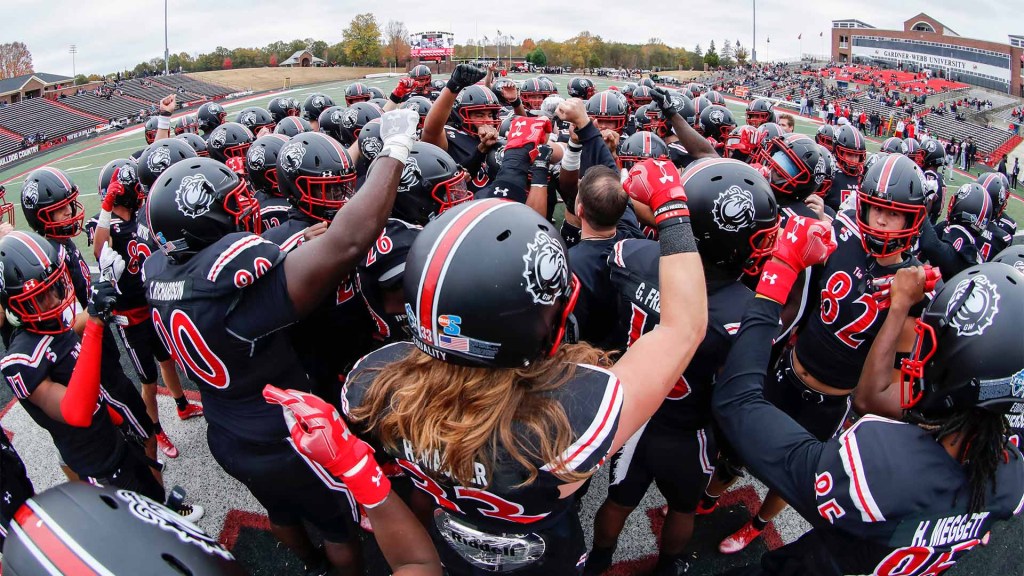
Moreover, only two of the Big South’s nine members – Charleston Southern and Gardner-Webb – compete in FCS. Bryant, a Rhode Island-based program which competed in the league last fall, departed for the Northeast Conference.

Meanwhile, the 11-member OVC has seven scholarship-level FCS programs, including Eastern Illinois and Western Illinois.
The OVC took a heavy hit when Eastern Kentucky and Jacksonville State left for the Atlantic Sun Conference in 2021. Austin Peay bolted for the ASUN the following year.
Murray State, which had been an original OVC member in 1948, left in 2022 to join the Missouri Valley Conference in all sports with the exception of football. The Racers played their first season in the Missouri Valley Football Conference last fall.
Western Illinois, a charter member of the Gateway Conference — which evolved into the MVFC — joins the Big South-OVC this season.
The roundtable panel
Mix all of this with the ever-changing nature of intercollegiate athletics, and you’ve got more questions than answers.
That led Prairie State Pigskin to search for some possible solutions, or at least plausible responses, to a handful of these ongoing questions.
We reached out to seven media members covering the league to provide some insight to the pieces of the puzzle. We got responses from the following three.
Mike Bradd, Eastern Illinois play-by-play broadcaster since 2000. He was honored with the Ohio Valley Conference Media Award in 2015.
Jacob Conley, who covers Gardner-Webb for the North Carolina-based TheDigitalCourier.com He is also a GWU graduate.
Davis Gregory, who enters his second year as the University of Tennessee Martin play-by-play broadcaster. Prior to that, he called Skyhawk football games for four years on the student radio station, WUTM.
Q&A
Have any of the recent additions or subtractions to the Big South-OVC surprised you? Why or why not?
Bradd: I’m not really surprised. I knew Western (Illinois) was a possibility for the last couple of years. I’m really glad that they’re a member now.
I’m still a little perplexed about Austin Peay and Eastern Kentucky. I understand why they left, but I don’t understand why they left for where they did. I don’t know if they’re in a better place or whether they think they are, but that’s their business.
Conley: Not really. When the Big South went down to two original members, I figured it would have to combine with somebody. Although I thought it would be with the ASUN due to the Southern geographical footprint and the fact that GWU was a member of the ASUN for all sports but football for the 2002-2008 seasons. The Big South/OVC combo has worked out well so far though.
Gregory: I’ve been surprised at how many Big South teams have decided to leave the association. I think that if both conferences truly had all their members when the association was formed that this could be a formidable conference and one where Missouri Valley and Big Sky teams would want to schedule matchups.
How do you see the league managing these changes over the next few years?
Bradd: I don’t really know, but it almost seems like you’re just reacting all the time. It would be nice to add a 12th member to even out the basketball schedule and the teams didn’t have to take a Saturday off every once in a while. But, I don’t know who that 12th member would be.
Conley: They have done well so far. They just have to stay on top of the NIL craziness even though it is like trying to ride a bull for far more than 8 seconds. One suggestion I would have is to try to foster a rivalry with GWU in conference play. It really hasn’t had one since Liberty left. Anyone who went to GWU from the early to mid-2000s can’t stand LU. When they played, it was called “The Baptist Bowl”. That was the biggest game of the year regardless of record. GWU just doesn’t have that right now like some of the other conference teams do.
Gregory: The league will target teams in between the OVC schools and Big South schools to help accommodate travel.
What are the biggest opportunities for the league?
Bradd: The positive is that the league is better off membership-wise today than it was a couple years ago when Austin Peay, Eastern Kentucky and Jacksonville State left, followed by Murray State and (non-football member) Belmont.
I really like the competitive balance in the league now. For a time there, Jacksonville State was much more committed (financially) than anybody else and Murray and Belmont were much more committed financially in basketball than anybody else. It was really hard for pretty much the rest of the league, including Eastern Illinois, to compete with those people.
With them all gone, I see a group of schools that seem to have the same commitment, top to bottom. I don’t see anybody who is going to throw a whole bunch of money at it and dominate in either football or basketball. And that’s good. It makes it more fun for everybody to have a chance at it when the season starts.
Conley: Expand the footprint. In a dream scenario, poach somebody like Wofford, Furman or even South Carolina State. That would strengthen the league portfolio and turn the Big South/OVC into a multi-bid league like the Big South used to be with Liberty and Coastal Carolina. I think this league has a lot to offer and should make a strong effort to showcase it to other teams so they will want to join.
Gregory: The biggest opportunity for the league is for its members to schedule tougher non-conference competition so when conference play begins, there’s a shot that some teams will be ranked and that could help an at-large bid to form.

What are the biggest challenges?
Bradd: If you talk to the ADs, it’s going to be finance (based) long-term, particularly with whatever shakes out at the FBS level and with court settlements. It sounds like the FCS schools are kind of having to subsidize some of the costs the FBS schools are paying out to their former athletes. How all that shakes out is apparently going to be an issue.
College athletics is pretty broken right now with the transfers and NIL and no real rules. People are just flashing money around and buying players from other teams. I never thought it would get like this.
So, I don’t know if the OVC is any different from anybody else when it comes to all that, except they probably have to react more than be proactive. The bigger schools can be more proactive and the smaller ones are more reactive. And ultimately are those power schools going to break away? Are they going to expand the NCAA basketball tournament and leave the smaller leagues into some sort of a play-in situation where they’re really not in the tournament automatically like what happened with the NIT?
I just think there’s a whole bunch of unsettled things right now.
Conley: Retention. Make a greater effort to show student-athletes that the Big South/OVC is a destination league and not merely a stepping stone to the next level. For example, GWU has over a 95 percent roster turnover from its championship team from last season. I’m sure other teams in the league have similar issues just to a lesser extent. The conference needs to work with the member institutions to address this issue.
Gregory: I’d say travel. The trip from UT Martin to GWU or Charleston Southern is not a short one. It’s a long haul for the OVC schools, and I’d like to see a team get added that is in between (those two schools and the rest of the assocation).
What is the best-case scenario?
Bradd: Probably to just stay somewhat where they are now. You would probably like to have an even number of (football) teams. It would make the scheduling work a little better. But with nine teams, it’s eight conference games and three non-conference games in a typical 11-game season. It’s a good mix.
I really like the fact that you play everybody, that it’s a full round-robin. It hasn’t been that for a little bit. The last couple of years it’s maybe affected the league championship because people didn’t play each other. Now, that won’t be the case going forward.
If the FCS stays pretty much like it is, although that may not be the case, status quo might be the best-case scenario. I don’t see that we’re going to expand a whole lot unless there’s a couple of opportunities out there. Some people have talked about a school like Indiana State, but I don’t really see that happening particularly with the basketball success they’ve had. I don’t see any reason why they would want to move out of that league.
Conley: The conference somehow masters the monster of NIL and keeps the best athletes from jumping ship for supposed greener pastures. If it can do that, and expand its footprint as discussed above, the Big South/OVC has a chance to become one of the top conferences in FCS football.
Gregory: The best-case scenario is that the teams start to win their non-conference games against top-25 teams and that helps bring another bid into play for the league.
What is worst-case scenario?
Bradd: There are a number of different things. No. 1 would be people leaving the league and leaving us without enough members. If there’s a big shakeup at the power conference level and that leaves the schools at Eastern’s level kind of out in left field without access to things like the NCAA basketball tournament. Who knows what happens with FCS football? Those would be the two biggest ones I think of right off the top.
My crystal ball is not very good on this. I feel like the current situation is not sustainable. Something is going to have to happen. Somebody is going to have to bring some order to it. It appears that that order is going to be in the form of the big schools making these athletes employees.
Eastern will never do that, but I don’t know if anyone in the OVC can do that. That’s why I like the fact that everyone in the league is kind of in the same place.
When someone does commit more (financially), that’s where the road splits, but I don’t know where that is at that point.
Conley: It folds. I’m not sure of the financial stability of other schools in the league, but GWU is in dire straits. It has cut athletics staff positions to a bare minimum over the last few years to save money.
For example, the SID office is down to one full-time person now and there is no way it can operate on the D-I level with one person. If this keeps up, my guess is GWU will have to drop down to D-II in three to five years.
Worst case, it goes the way of Birmingham Southern (which closed its doors following the spring semester), who was D-I and in the Big South not that long ago comparatively. If other conference schools are in the same boat, I am afraid they, and by extension the conference, will die a slow painful death.
Gregory: The league remains a one-bid conference.
Dan Verdun is a co-founder of Prairie State Pigskin. He has written four books: NIU Huskies Football, EIU Panthers Football, ISU Redbirds Football and SIU Salukis Football.
Find us on social media!
Twitter: https://twitter.com/PSPigskin
Facebook: Prairie State Pigskin
Instagram: Prairiestatepigskin
 Prairie State Pigskin
Leave a comment