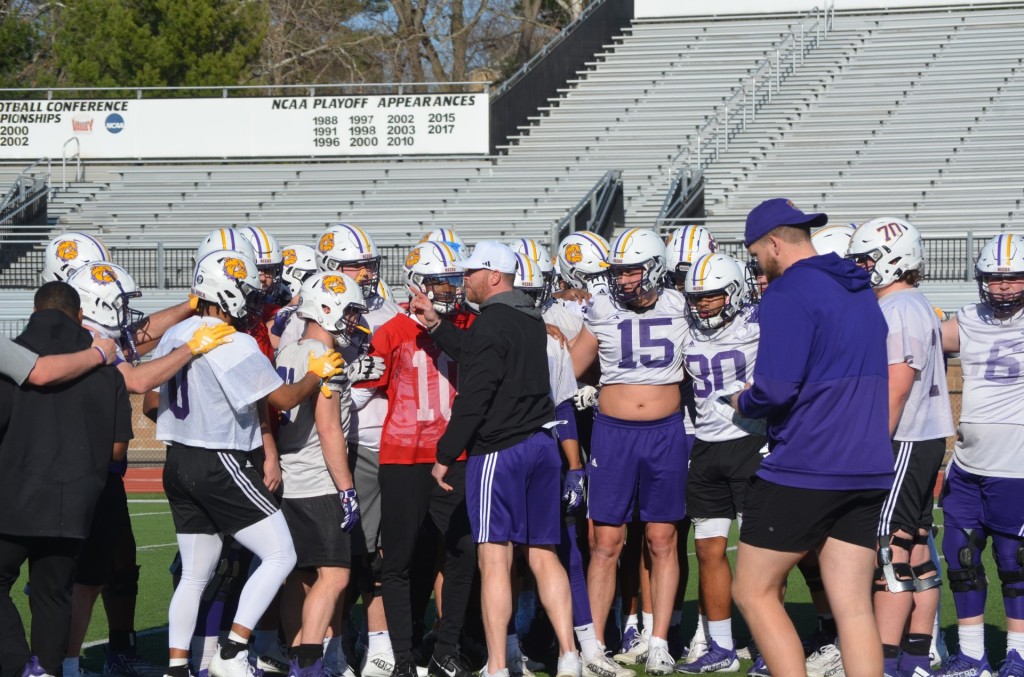
First-year Western Illinois head coach Joe Davis addresses his team during spring practice. The Leathernecks will host the annual Bruce Craddock Spring Game at 6 p.m. April 19 at Macomb’s Hanson Field. (Photo by WIU Athletics)
By Dan Verdun
After spending nearly four decades in the same conference, Western Illinois University has begun a new era in its football history.
“I think excitement is the general thought process here, excitement and enthusiasm,” first-year head coach Joe Davis said as WIU opened its spring practice last week.
While this is Davis’ first time leading a program, the Midwest native brings 20 years of coaching experience to Macomb.
“We had as good of a first eight weeks as we possibly could have as a football program when it comes to weightlifting, speed and conditioning, and now we get the chance to put the ball down, play a little bit, coach, teach and I think everyone is excited to do that,” said Davis, who spent the last two seasons as the offensive coordinator at Eastern Illinois.
WIU was a charter member of the Gateway Athletic Conference in 1985. The Leathernecks spent 39 years in the league, which evolved into the Missouri Valley Football Conference in 2008 when the first of the Dakota-based schools joined.
All that changed last spring when Western announced it would join the Ohio Valley Conference. While WIU’s other athletic teams entered the OVC for the 2023-24 academic year, the Leathernecks played a final MVFC season last fall.
A change of seasons
Two years ago, under then-head coach Myers Hendrickson, WIU had less than 55 players, which was not enough to hold a spring game. Instead, the Leathernecks ran through drills to culminate spring practice.
Hired in December, Davis spent the early part of winter putting together his staff and building his program.
With nearly 80 players presently on the roster, the 44-year-old Davis views this spring as a key step toward success in Western’s new league.
“I think we need more (players) in the spring. We’re still working on that, but having a little bit of depth and competition, going back to the mid-year, adding those 17 players, we couldn’t be more excited about that group. We added to the style of play we want to play here, so those numbers are going to be big,” Davis said.
Whatever the final roster size turns out to be by WIU’s season opener Aug. 31 at FBS Northern Illinois, Davis wants a team that plays a physical brand of ball.
“We’re going to be a tough, physical football team here,” he said. “I want to practice that way. I’ve said forever, even as a quarterback coach, if you want to be a good tackling team, you have to tackle in practice. It’s like any other skill that needs to be taught, developed and repped.
“Certainly among the confines of health and rules and structure of practice, we’re going to be smart with our players but at the end of the day, I want to come out of spring saying this was a physical spring,” he said. “We were able to hit and tackle and have live periods in practice to see what type of team we have.”
Valley views
During its time in the Gateway/MVFC, Western won four conference titles and earned a share of another.
WIU produced 11 conference players of the year — seven on offense and four on defense. Two players, linebackers James Milton (1998) and Ed Hartwell (2000), won the Buck Buchanan Award as the nation’s outstanding defensive player.

The Leathernecks, however, have not posted a winning season since 2017. That year also marked the last WIU playoff appearance.
Western has lost a program-worst 24 straight games, dating back to 2021. That is also the longest current losing streak in FCS.
Minnesota-based Sam Herder has covered the FCS since 2012. Herder, HEROSports senior FCS analyst, shared his view on Western’s move to the Ohio Valley Conference.
“The negative of WIU moving to the OVC is leaving the top FCS conference for a league with a bit more instability,” Herder said. “The OVC and Big South needed to merge due to low numbers, and the joint league isn’t seen as a conference that will be getting three bids into the playoffs.
“But on a positive (note), WIU will be more competitive in the Big South-OVC than the MVFC,” he said. “WIU had some strong years in the MVFC, but there’s been lean seasons recently. It’s hard to build program momentum when you’re a bottom team in a conference. If WIU can build itself into being a winner and a contender in the Big South-OVC, you can reignite some fans and get some momentum back on your side and on the recruiting trail.”
Examining past Leatherneck glory
Kevin Capie of the Peoria Journal-Star covered Western Illinois football for two decades, beginning in the mid-to-late 1990s. He attributes the Leathernecks’ “glory years” in the Gateway/Missouri Valley to being in “the right place at the right time in a lot of ways.”
Capie noted that it was the pre-Dakota schools era of the conference.
“You also had schools that were powers (in the past) like Southern Illinois with the 1983 national championship that had struggled (in the following years),” he said.
Capie noted that WIU also had good coaching staffs that “really tapped into the I-A transfers” the likes of former Wisconsin Badgers running back Aaron Stecker, who came to Macomb and rushed for 3,799 yards in just two seasons.
“(Back in those days) you couldn’t transfer laterally (and not have to sit out a year) like players do now with the portal,” Capie noted.
Thus, the Leathernecks grabbed “a lot of high-end talent that would come for a year or two and perform really well for (WIU head coaches) Randy Ball and Don Patterson, and they found a way to merge those players as a team.”
That success led to better high school recruits, according to Capie.
“It was a perfect storm,” he added.
Changing trajectory
Enter the Dakota schools, first with NDSU and SDSU in 2008 followed by USD in 2012 and UND in 2020.
“It really changed the Valley in a lot of ways,” Capie said. “It brought the Valley up (as a conference), but Western was never really able to meet that just because of all the funding issues they’ve had. Other schools were able to get their donors to be able to compete (in the new facilities arms race).
“Western was always sort of stagnant. You can see that in the facilities. That’s where Western started lagging.”
Compounding things, Capie noted the Dakota schools were flagships for their states, and therefore looked better in the eyes of recruits and transfers.
Western, on the other hand, wound be “fourth-best at best” in the state with the University of Illinois and Northwestern University standing on top.
“Once the Dakota schools came in, that arms race was now going on in terms of facilities and it was tough for Western to match with the funding,” Capie said. “Then you start losing the players because they want to go where everything is new and improved.”
Capie left the newspaper industry in 2015 to teach at Bradley University. Today he is the faculty advisor for The Vidette, the student newspaper at Illinois State University.
Capie continues to follow collegiate sports. He agrees with WIU’s move to the Ohio Valley.
“It evens the playing field a little bit for them in terms of facilities. Everyone looks at the (Missouri) Valley as the SEC of the FCS, which there is a lot of truth to when you look at it top to bottom,” he said. “(Moving to the OVC) will help balance things out for Western. It won’t happen overnight, but they can at least be competitive.”
Backing up his point, Capie noted that WIU had done well in non-conference games against OVC programs in the past.
“Having that now over an 11- or 12-game season versus just one or two and then going into the Missouri Valley schedule where it’s so tough will do wonders,” he said.
No depth charts
To reignite the Leatherneck program as well as the fanbase, Davis and his staff are wiping the slate clean and taking a fresh approach.
“We told the team, don’t worry about your position on a depth chart,” Davis said. “There are no depth charts. Make your reps count. Don’t count your reps, and there are guys here in practice one who are going to be playing a different position by the time we get to practice 15.
“We want guys here who are going to lead the league in effort, be coachable, be teachable, have great energy and enthusiasm, and if we can check all those boxes within our roster, we’ll find good homes for all these guys.”
Dan Verdun is a co-founder of Prairie State Pigskin. He has written four books: NIU Huskies Football, EIU Panthers Football, ISU Redbirds Football and SIU Salukis Football.
Find us on social media!
Twitter: https://twitter.com/PSPigskin
Facebook: Prairie State Pigskin
Instagram: Prairiestatepigskin
 Prairie State Pigskin
Leave a comment