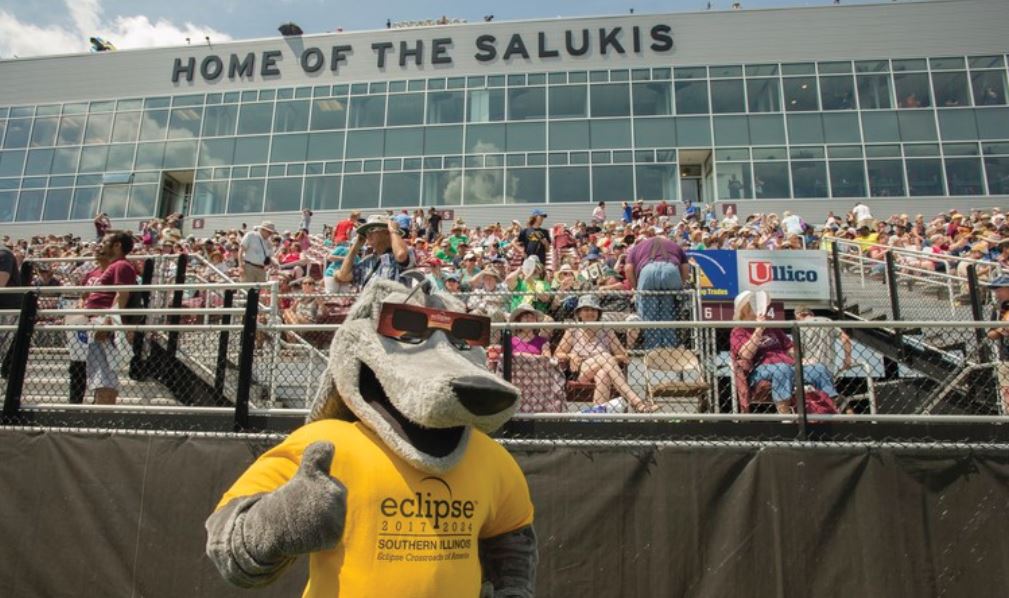
Saluki Stadium in Carbondale will be busy April 8 with scientists and enthusiasts who want to view a total solar eclipse. (Photo by SIUSalukis.com)
By Barry Bottino
Pro football scouts regularly roam the sidelines at Southern Illinois University looking for talent.
On April 8, another group of professionals will be scouting at Saluki Stadium for something unique – a total solar eclipse.
Scientists from NASA, broadcasters from The Weather Channel and multiple TV networks, along with space and weather enthusiasts from around the country, will set up at SIU’s football stadium for the event, bringing national attention to the region.
Carbondale and SIU last hosted an eclipse event in August 2017. This time, visitors will see 4 minutes, 9 seconds of totality for the eclipse, more than double that of seven years ago.
“It’s really cool,” SIU head coach Nick Hill said. “NASA comes and takes over our field.”

Hill’s team will experience a short break in spring practices for the event, which has been dubbed the Southern Illinois Crossroads Eclipse Festival. The Salukis will not practice April 6-8 during the festival.
That break is only a minor disruption, and no other sports on campus will be impacted, according to SIU athletic director Tim Leonard.
“It’s pretty nominal,” he said, noting the main difficulty around campus will be traffic.
In 2017, the break was much different for SIU football.
“The last time, that was during fall camp,” Hill said. “We had to shut down camp for three days.”
Leonard was not with SIU in 2017, so he’s excited to take it all in.
“We’re going to get a lot of media attention. We’re going to get a lot of people coming into the region,” he said. “From an economic standpoint, it’s going to be really big. They’re anticipating a big crowd here on campus to watch the eclipse and take in all the activities.”
One benefit, according to Leonard, will be having visitors on SIU’s campus and in the football stadium who haven’t been there before.
“I’m just excited to see it and be a part of it,” he said.
Eclipse timeline
Though there will be a full schedule of activities surrounding the eclipse from April 5-8, the show on April 8 is as follows:
12:43 p.m.: Partial phase begins
The moon starts to covers the sun. This process lasts about 90 minutes. Viewing should only take place with special solar filters or solar safety glasses.
1:59:16 p.m.: Total eclipse begins
The moon will totally cover the sun, blocking all direct sunlight.
2:03.24 p.m.: Total eclipse ends
Lasting for 90 minutes, the sun will start to reappear and go through a second partial phase.
3:18:10 p.m.: Partial phase ends
The sun is fully back in view.
Barry Bottino is a co-founder of Prairie State Pigskin and a 19-year veteran of three Illinois newspapers. He has covered college athletics since 1995.
Find us on social media! Twitter: https://twitter.com/PSPigskin
Facebook: Prairie State Pigskin
Instagram: Prairiestatepigskin
 Prairie State Pigskin
Leave a comment