
Illinois State walk-on Jimmy Makuh (17) serves as the Redbirds’ scout team quarterback. (Photo by GoRedbirds.com)
By Dan Verdun
Jimmy Makuh spends much of his time on the football field impersonating someone else.
As the Illinois State scout team quarterback, Makuh helps prepare the Redbird defense each week by playing the role of the upcoming opponent’s signal caller.
“We take time to study their offense and run it for our defense,” he explained.
Makuh and other Illinois FCS athletes on scout teams play an important role in getting their teammates ready for gamedays by providing a look at what opponents do well.
So far this season, Makuh has played the likes of Western Illinois quarterback Matt Morrissey, Eastern Illinois QB Pierce Holley and South Dakota State All-American Mark Gronowski.

“Our role in winning on Saturday is doing well on the scout team. We’ve got to give our defense a look to make sure they’re ready for what’s coming,” Makuh said.
After setting the single-season passing record at John Hersey High School in Arlington Heights, the 6-foot-3 Makuh had scholarship offers to play at the Division II level.
“I came to Illinois State pretty late as a walk-on,” Makuh said. “My dream was always to play at the highest level (possible). When I did make my decision to walk-on here, of course there were the people saying that’s the wrong decision and that you should go somewhere where you’re going to play.
“But my parents believe in me and the people who matter believe in me, so I took this (opportunity) and I’m going to keep grinding here.”
For now, Makuh – who also played prep basketball – understands and accepts his role.
“That’s our role in the win,” he said. “That’s what I try to prioritize. That’s the way I think of it.”
Be prepared
Today, Illinois college football fans know Nick Hill as the head coach of nationally ranked Southern Illinois.
Yet, once upon a time, he was just trying to make his way as a Saluki football player after transitioning from playing basketball at Western Kentucky.
“I was a scout team player,” Hill said. “Our center and I used to keep track of our stats (during practice reps).”
The duo tracked things such as completion percentage and targeted receivers, all while trying to improve and dreaming of playing on Saturdays.
While Hill’s story is unique to him, it’s a situation in which many players find themselves. Plenty of former high school standouts take on scout team duties during the week with game days spent standing on the sidelines.

The scout team is the team within the team, and it’s the squad that no one notices on Saturdays but whose contributions often help determine the outcomes.
“They are as big of a part of what we do as a team as any one of our starters,” Eastern Illinois head coach Chris Wilkerson said.
“A scout team is what makes a team a playoff contender. I think that’s the biggest thing people don’t notice,” said Daniel Sobkowicz, Illinois State’s star receiver.
Western Illinois captain and linebacker Anthony Quinney added, “They’re very valuable. They’re just as important as the starters. They can determine how we play on Saturday with the looks they give us and the schemes that they are assigned to do. It’s our look, which is basically our game plan. We have to execute in order for it to work.”
Scout team players also play a role in a program’s future, according to WIU head coach Myers Hendrickson.
“We have them run our Western Illinois offense and defense against each other so we can continue to evaluate and develop our program,” he said.
Hill said, “I tell them all the time, they’re a part of every win whether they get their name in the paper or not. They’re a huge part of how and why we’re successful.
“Everybody has a role. And their roles are just as important as anybody else’s.”
Working overtime
So how should a scout team member’s job description read?
“The guys have to simulate the opponents every single week. At some point, whether we have great depth at a position or whether you’re younger or just paying your dues, it’s kind of part of the process,” Wilkerson said.
Sobkowicz spent time on the scout team his true freshman year.
“The scout team basically goes up against the starters every single day in practice,” the redshirt sophomore said. “It definitely takes a lot to do that.”
“They bust their tails,” Wilkerson said. “In addition to the practices they’re already going through during the course of the week, they’re getting an extra developmental (weight) lift every Friday. They’re putting in as much time, if not more, trying to sharpen their skills and help us as a football team.”
While each team’s starters and key role players often get respites during the rigors of the season, such is not often the case for scout team players.
“Sometimes those guys don’t get a ton of breaks during practice,” Wilkerson said. “If you’re a scout guy on let’s say the defensive line where we’re a little thin (due to injuries), you may be taking the whole 25 plays during our team period.
“If you’re lucky, you might get a play or two off, where our offensive guys will typically go five or six plays and then take four or five plays off (and continue that cycle).”
Rudy duty
Given the demands, many a family member, friend or interested party may wonder why a player would want to put himself through all this without so much as the promise of a “Rudy-like” Hollywood moment during an actual game.
“It’s definitely not the position you want to be in, but it’s a place where you can really realize ‘wow, I’ve made a difference this week,’” Sobkowicz said.
Scout team players also build strong bonds with coaches — such as Makuh’s relationship with ISU offensive coordinator Tony Peterson — because they work so closely together all week.
“Coach Petersen and I have gotten pretty close,” Makuh said. “I know he and the other offensive coaches believe in me. I’ve gotten plenty of shots, and I know more are coming.”

Eastern Illinois tight end Mike Jarosz has certainly paid his dues.
Now a junior, Jarosz played “a true fullback” at Wheaton North in his prep days. He spent his freshman year at Western Illinois University – but only as a student.
“I tried (to walk on at WIU),” he said. “I missed the game a lot. I was still practicing on my own, so I decided to leave and go to another school.”
With the help of Joe Wardynski, his high school coach, Jarosz found that other school. He transferred to EIU in fall of 2019 and joined football program in January 2020.
“I was originally supposed to play (at EIU that fall). The coach at the time (Adam Cushing) said he didn’t have enough spots on the team at that current semester,” Jarosz said.
Cushing resigned as EIU head coach in January 2022 for an assistant coaching position at FBS Duke University.
Jarosz persevered. Along with scout team duties, he has played mainly special teams in addition to sparingly as an EIU reserve linebacker. After last month’s victory at Northwestern (La.) State, Jarosz was recognized as EIU’s Offensive Scout Team Player of the Week.
“I just enjoy playing football and being here with my boys. I love everything about it. I love the team. I love the competitiveness,” he said.
Inside recognition
Scout teamers certainly are valued, but little outside fanfare comes their way.
Their coaches, however, realize their importance and seek to reward the scout teamers’ dedication.
Numerous schools recognize scout team members with weekly awards and other means of appreciation.
“Those guys’ ability to give us a quality look helps prepare our offense and defense and special teams. They are very, very valued members of our football family,” Wilkerson said.
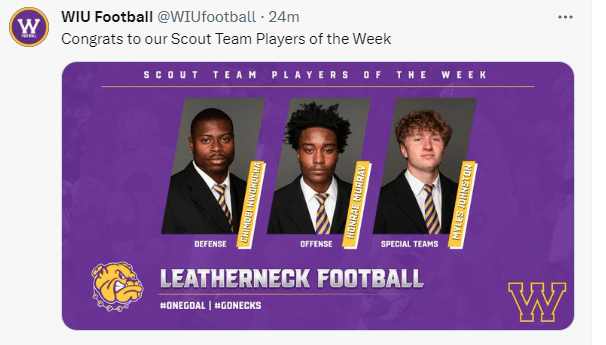
Time is devoted in staff meetings to discussing players who are excelling on the scout teams.
“It always means something when the coordinators on both sides of the ball keep bringing up your name,” Hill said. “We try to reward those guys with traveling throughout the season and dressing for games. You have to keep showing them and proving to them just how important they are throughout the week getting the team ready to play.”
The coaches also realize today’s scout team player could be an injury, suspension or a year’s development away from significant playing time.
“We call it our ‘Monday Night Football,’ which is our developmental practice. It’s no pads for the guys that played in the game on Saturday,” Hill said. “They come out there and we get a helmets practice in, but then the guys who are scout team players throughout the week or maybe didn’t get as many reps during the game, go out and play.”
ISU’s Sobkowicz is an example of one such player who stayed the course.
“I approached the scout team as ‘this is where I’m going to prove myself to the coaches,’” he said. “Had I slacked off, it definitely would have taken me off their radar. Scout team is where everyone can improve because you’re going against the best players on the field.”
Hill, whose undergraduate degree was in teaching, lays out the guidelines for this roster.
“I tell our players all the time that there will be guys who start out in that developmental practice for three, four, five weeks, and they’re going to end up playing for us. There will be meaningful reps for somebody. It’s how you approach that,” he said.
Hill, the former SIU star quarterback, has the experience to back it up.
“I was there once. That’s why we give a scout team player of the year (award). I can remember when I had to redshirt here (after transferring), I had a goal to win that thing. You’ve got to show up every day and practice and do whatever that side of the ball wants you to do,” he said.
So, did Hill win the award?
“I did,” he said proudly. “Shoot, I can remember that banquet. That was my first one with Coach (Jerry) Kill. My family was there, and I was excited to get it. I feel like that’s where I earned a lot of respect from the older guys, (including) the defensive guys, and the younger guys when I became the starter. I wanted my teammates to know how seriously I took everything.”
It’s still something he carries with him as a head coach.
“I tell our guys, you don’t get to play on Saturday, so when you get some team reps against the starters, (there’s your chance) to have some success,” Hill said.
And sometimes those “successful reps” aren’t what they seem.
Hill remembers Kill’s then-defensive coordinator Tracy Claeys directing him as scout team quarterback to purposely throw some passes that could be intercepted.
“(Our job was) giving them good looks,” Hill said. “That might mean leading somebody a little too much to make sure their (defensive) ball skills (stayed sharp).
“All the little things. It’s such an important piece of our success.”
Dan Verdun is a co-founder of Prairie State Pigskin. He has written four books: NIU Huskies Football, EIU Panthers Football, ISU Redbirds Football and SIU Salukis Football.
Find us on social media!
Twitter: https://twitter.com/PSPigskin
Facebook: Prairie State Pigskin
 Prairie State Pigskin
Leave a comment