
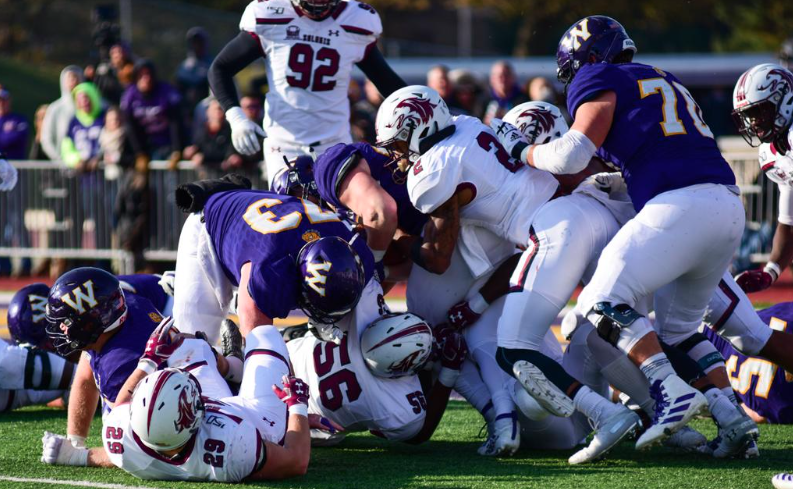
WIU and ISU will meet for the 106th time this fall. What happens after that remains up in the air. (Photo by Illinois State University)
By Dan Verdun
Western Illinois is preparing to embark on its final season in the Missouri Valley Football Conference before moving to the Ohio Valley Conference in 2024. What does this mean to its rivalries with Illinois State and Southern Illinois?
“Philosophically, leaving the Missouri Valley Football Conference really is tough because of the long-standing opponents we’ve had. But my goal was to try to maintain some of those relationships, and that’s still my goal,” WIU athletic director Paul Bubb told Prairie State Pigskin.
In fact, prior to WIU’s official announcement of its switch to the OVC in mid-May, Bubb had already reached out to ISU and SIU about continuing to play one another as non-conference opponents.
“Paul Bubb and I have already spoken about it. I certainly want to (pursue it),” SIU athletic director Tim Leonard said.
Illinois State interim athletic director Dr. Jeri Beggs said Bubb “reached out to me that very day, even before it was publicly announced, to let me know that it was going to happen and that he wanted to continue the relationship.”
Longtime rivals
All three schools, along with Eastern Illinois, annually played each other dating back to the days of the defunct Illinois Intercollegiate Athletic Association, founded over a century ago.
The league, which was renamed the Interstate Intercollegiate Athletic Conference in 1950 when two Michigan schools joined, saw SIU withdraw for the 1961-62 academic year. This brought about an interruption in the Leatherneck-Saluki rivalry.
The IIAC folded after the 1969-70 academic year, resulting in Western playing as an independent and then as a member of the Mid-Continent Conference into the first half of the 1980s.
Western, Eastern, Southern and Illinois State were charter members of the Gateway Football Conference in 1985. The Gateway also originally included Northern Iowa and Southwest Missouri State.
The league evolved over the years, changing membership and its name along the way. Eastern Illinois left for the Ohio Valley in 1995. Starting in 2024, the Leathernecks and Panthers will again square off as conference foes.
Western opens its last MVFC schedule hosting ISU Sept. 9 at Macomb’s Hanson Field. The Leathernecks entertain SIU Oct. 28.
For the record, Western and Illinois State have met 105 times. WIU has played Eastern and Southern 67 times each.
Keep the fire burning
All three athletic directors expressed the desire to continue playing one another. The trio also view future games as trade-off, home-and-home affairs.
“I just think it’s important for us to maintain those relationships as we look at future scheduling,” Bubb said.
Leonard said, “It works out great for us because now we’d get to play a local team, an Illinois team, in a non-conference game.”
Beggs said, “We’re definitely going to try to make that happen, we just don’t have any confirmation yet on which years.”
Why it would work
Budget concerns, established rivalries and general appeal are certainly reasons for the three schools to continue to meet on the football field.
“I like it because there’s a bit of rivalry to it, fans can get into it. I think the media likes it,” Leonard said.

“It’s been a great rivalry,” Beggs said. “It’s geographically very attractive because it’s so close.”
Macomb is 105 miles from Normal and 251 miles from Carbondale, according to Google maps.
“We like it from our travel budget standpoint,” Leonard said. “Any time you can have a relatively short bus trip for a non-conference road game, you like that.
“Travel costs have gone up 20 percent post-COVID. It’s expensive to go anywhere. Obviously when you’re in rural America, it isn’t easy to get to places or for people to come to you. If you’re getting on a plane, you’re probably having to charter, and that’s not cheap.

“We’re always looking for regional series that make a lot of sense. Anytime you can get on a bus, that’s good for the budget, but you also don’t want to be on a bus for seven hours either.”
Certainly there is a balancing act between budget and expanding your FCS resume.
“I think Illinois State, Southern and us all agree that we’d like that regional competition,” Bubb said. “In my career I’ve been a big fan of intra-conference rivalries. When I was at the University of Maine, we established a home-and-home series with the University of Montana. At that time, Maine was playing really good football. We were in the playoffs both years I was there (2001-02). Montana was consistently in the playoffs. They were the Grizzlies, and we were the Black Bears. It was fun putting that together.

“At the same time, I appreciate Western as a part of the Missouri Valley Football Conference playing a part in the Big Sky Conference matchups in the past (2017-21). But when you look at it from a budget standpoint, a charter flight is going to cost you $100,000. And when you do a charter flight, here’s the thing, we have to bus up to the Quad Cities or down to Quincy to get on a charter flight. And once we land in a Missoula or a Bozeman or a Spokane, you have to charter a bus to get to your destination.
“And how do you generate the revenue to support those types of games? We’ve got to get to a point where we’re generating revenue so we can do a challenge game like that.
“So, in simple terms, for us a to play at a school that we can bus to, it’s going to be $100,000 less than if we were going to charter someplace.”
Thus, it makes sense for WIU to seek non-conference games against the likes of Illinois State, Southern Illinois and Northern Iowa (210 miles from Macomb).
The challenges
While the desire to play one another is there, making these future games a reality isn’t always as easy as it seems.
“Non-conference games are always the hardest to schedule,” Leonard said. “We’ve talked about trying to figure something out where we can do a home-and-home series and keep that consistent with what we’re doing with SEMO (Southeast Missouri State).”
Beggs said, “As you can imagine, there are going to be some years where it’s going to work and years that it might not depending on where there are holes in the schedule. One of the things I’ve learned is that football schedules out a long, long time in advance.”
With WIU exiting the Missouri Valley Football Conference after this fall, the league will restructure its schedule in 2024.
“We’ll continue with an eight-game league scheduling model after WIU departs and we are back at 11 teams,” MVFC associate commissioner Greg Walter said in an e-mail.
Possible future dates
According to a Southern Illinois administrator, the Salukis typically play a guarantee money FBS game and two FCS opponents — one home, one road — for their non-conference games.
One of those two FCS games will likely always be SEMO because of the regional rivalry. That series is under contract through 2025 and will likely be extended, the SIU official said.
SIU has Austin Peay scheduled for the next two seasons and UT Martin on the books for 2025 and ’26 for non-conference games.
Consequently, the soonest the Salukis and Leathernecks could face each other would be 2025 — if that turns out to be a year in which FCS teams are allowed to schedule 12 games. Otherwise, 2027 appears to be the earliest possibility.
“The games historically have been competitive,” Leonard said. “It swings from one side to the other depending on the era and who’s doing well at the time. It would be a great non-conference series, and Paul and I are trying to carry that series forward.”
As for Illinois State’s schedule openings, an athletic administrator said there is a possible opportunity on its end as early as 2024. However, 2025 is already booked from a non-conference standpoint.
Find us on social media! (Twitter: https://twitter.com/PSPigskin, Facebook: Prairie State Pigskin)
 Prairie State Pigskin
Leave a comment